Episode 7: We Shall Overcome: The Presidio Mutiny
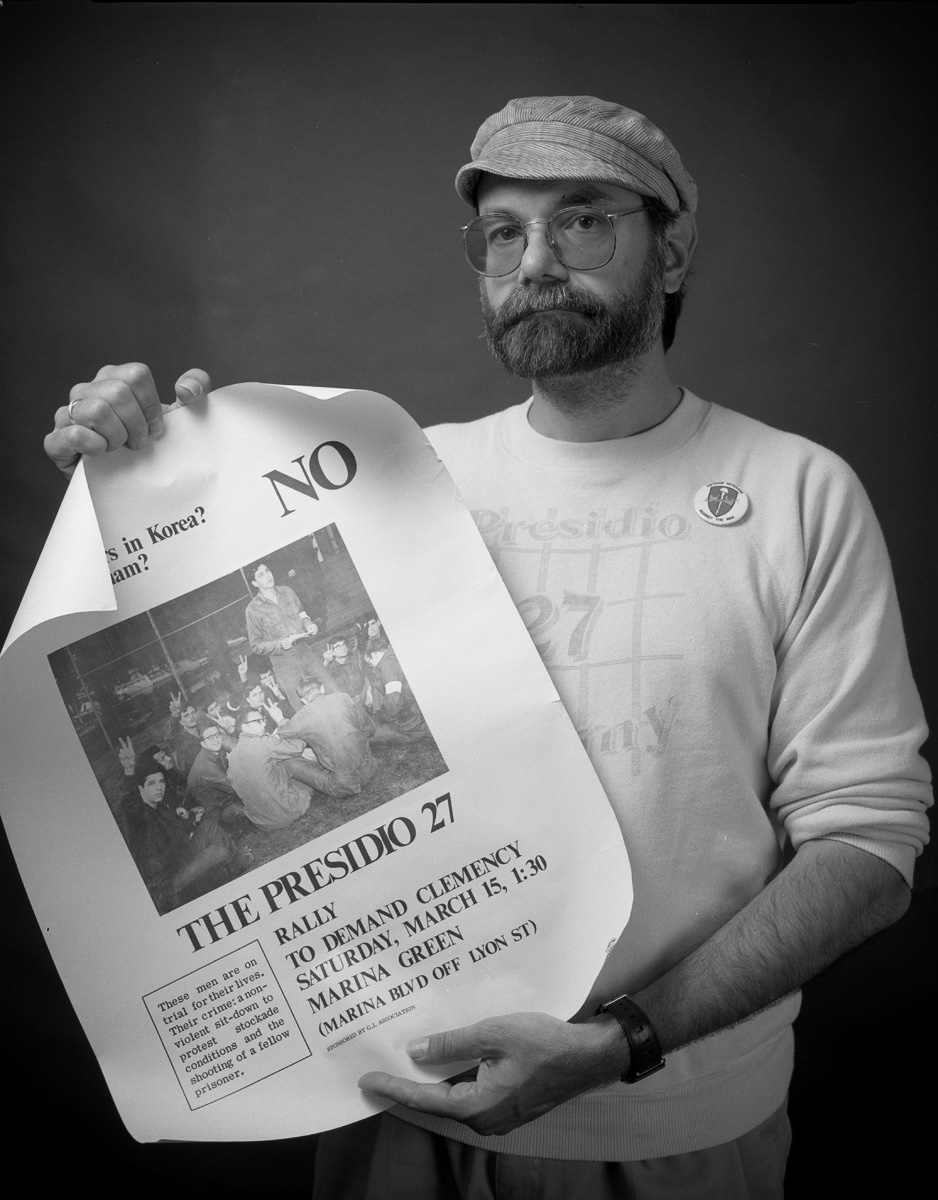
On October 14, 1968, at San Francisco’s Presidio Stockade, 27 anti-war GIs staged a bold act of civil disobedience. Protesting brutal prison conditions and the moral wrong of the Vietnam War, they sat down on the stockade lawn, locked arms, and sang “We Shall Overcome.” For this nonviolent protest, the Army charged them with mutiny—a crime punishable by death—and sentenced them to more than a dozen years in prison. In this episode, we hear from members of the Presidio 27, their lawyer, and fellow GI resisters as they recount their defiance and expose the injustice of the war they opposed.
Guests/Subjects
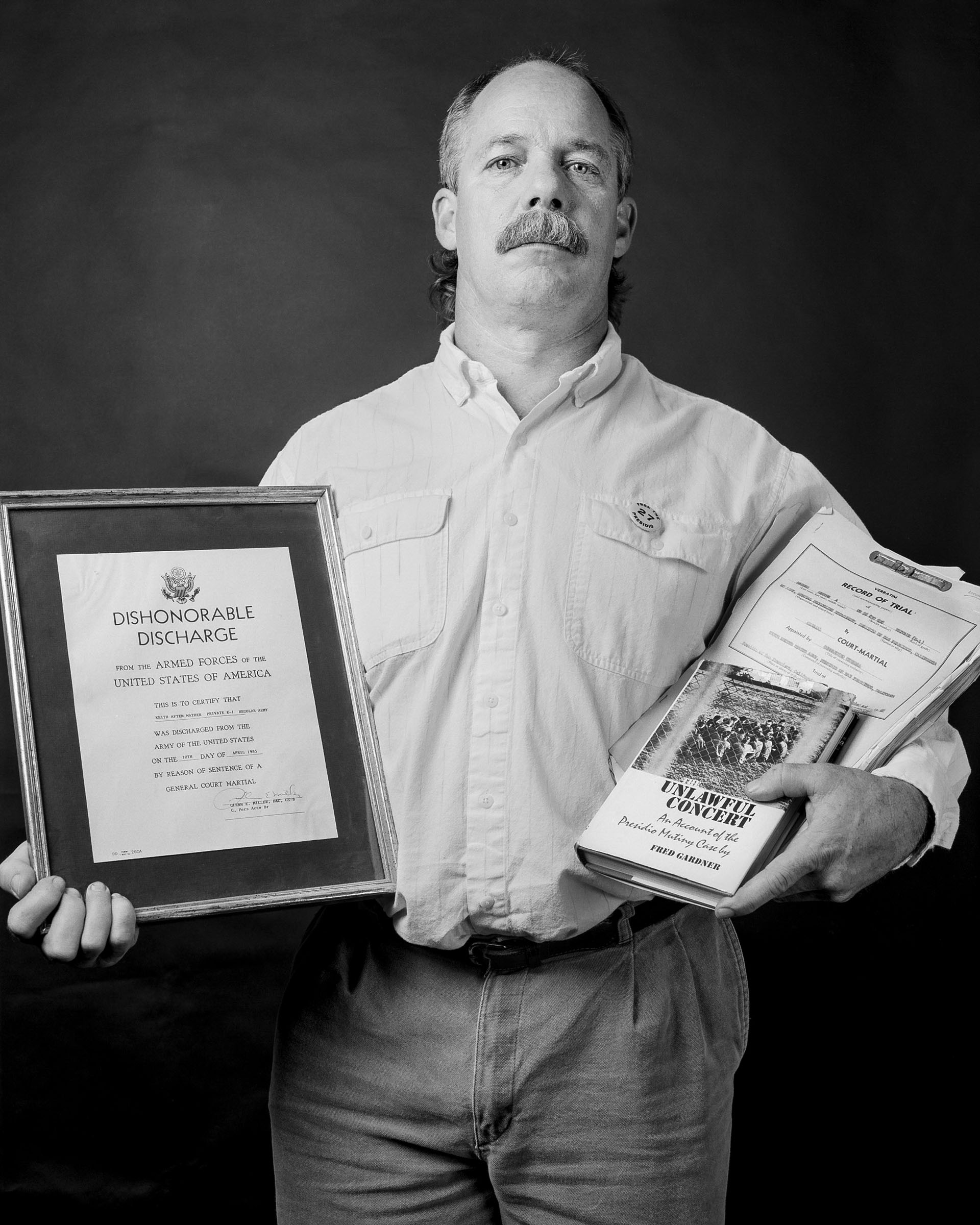
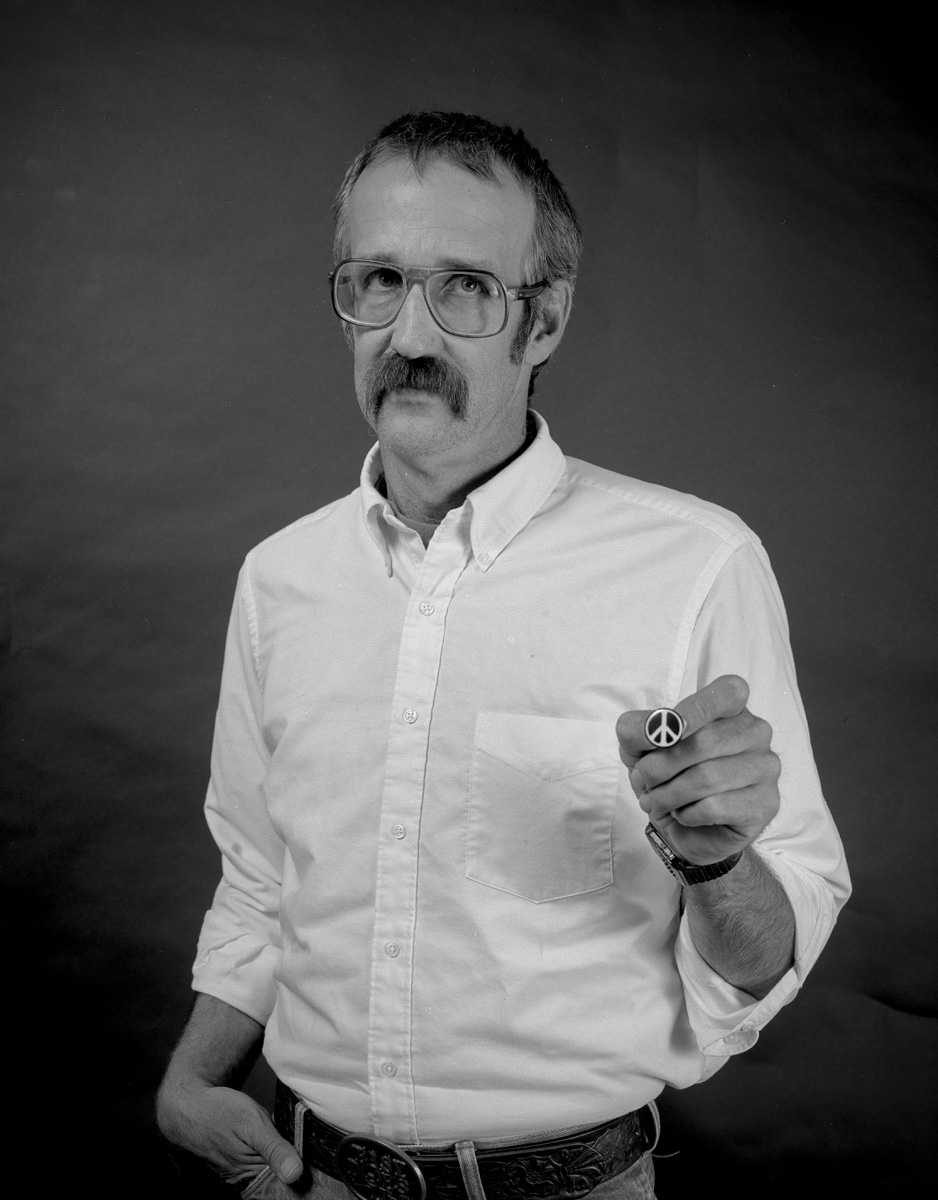
- Keith Mather: Drafted Army 1967-85. AWOL, participant in the Nine for Peace and Presidio 27 Mutiny. Escaped Presidio stockade and deserted to Canada. Secretly returned to the US in 1980, arrested in 1984. Imprisoned and court-martialed after serving 4 ½ months. He retired from the San Francisco Department of Building Inspection and remains an anti-war activist.
- Roger Broomfield: Drafted Army 1967-69. MP, Presidio Stockade guard. Testified at the mutiny trial on behalf of the Presidio 27. Became a carpenter in the Bay Area.
- Ricky Lee Dodd: Drafted Army 1968-70. AWOL, court-martialed, imprisoned for one year in Presidio Stockade, SF. Participant in the Presidio 27 Mutiny. Transferred to Leavenworth Federal Prison for additional one-year sentence. Deceased.
- Howard DeNike: Ricky Dodd’s lawyer who fought the mutiny charge. At the time DeNike worked with SF Neighborhood Legal Aid Services. After the Presidio Trial, he served with the Lawyers Military Defense Committee in Germany and Vietnam. DeNike earned a graduate degree in cultural anthropology, and self-published a book called They Also Served: Voices of the Overseas Law Projects from the Vietnam War.
- Randy Rowland: Enlisted Army as a medic 1967-69. AWOL 45 days while preparing a second CO application. Imprisoned at Presidio. Took part in Presidio 27 Mutiny. Court-martialed and sentenced to 21 months. Released from Leavenworth after serving 18 months. Rec’d Dishonorable Discharge. Retired emergency room nurse in Seattle.
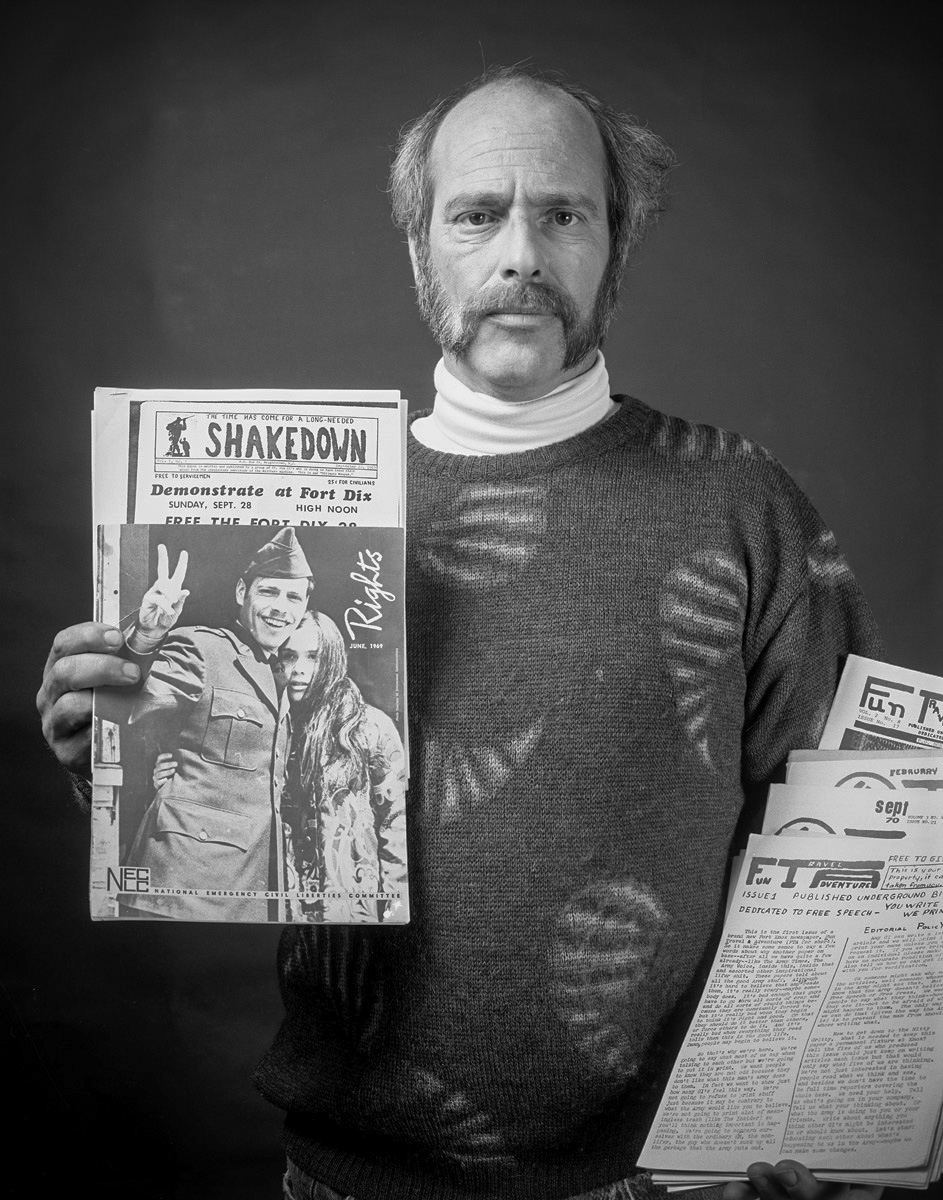
- Hal Muskat: Enlisted Army 1965-70, including 6 mos. Bad time in stockade. Stationed in Germany, refused to go to Vietnam. Court-martialed twice for distributing unauthorized literature at Ft. Dix.
- Background and extra material:
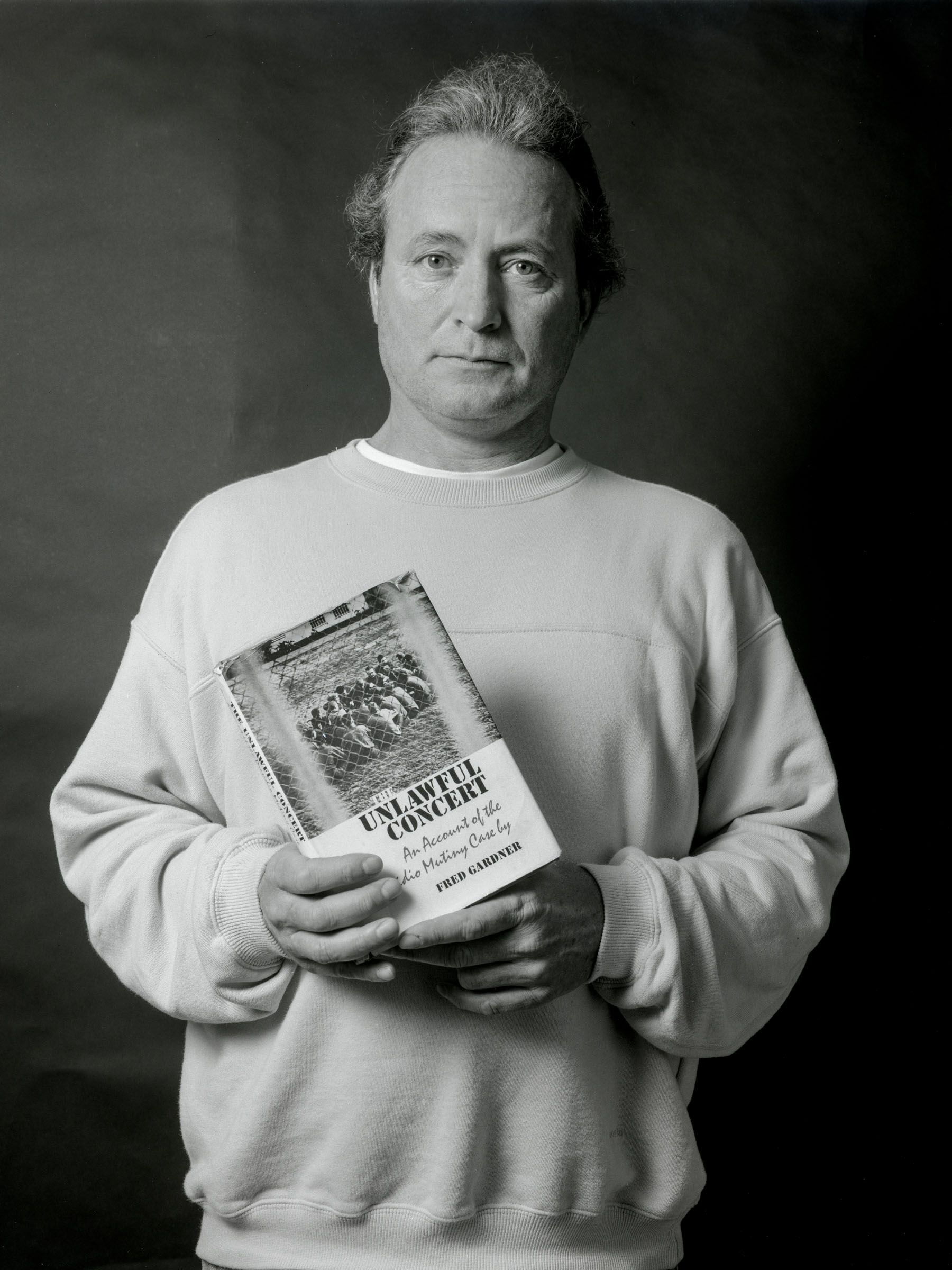
- The Unlawful Concert (1970) by Fred Gardner
- A book-length account of the Presidio Mutiny
- They Also Served: Voices of the Overseas Law Projects from the Vietnam War by Howard DeNike and Judith Mirkinson.
- The Presidio Mutiny of 1968 – FoundSF
- Defending the Mutineers by Fred Gardner | O’Shaughnessy’s
- Randy Rowland’s recollection of the Presidio Mutiny
- Presidio Mutiny Case (Article in the Fifth Estate) Issue 76, April 3-16, 1969
- Includes a chronology and affidavit by Linden Blake
- Demonstration in support of Ronald Lockman – Bay Area TV Archive
- TV report on Ronald Lockman refusing to go to Vietnam. Young Terence Hallinan interviewed.
- Slideshow of photo stills of the Presidio Mutiny with Pete Seeger’s “We Shall Overcome”
- Robert (Bob) S Lamont | Vietnam War Era Remembrance
- Video Interviews about the Presidio Mutiny – from the film Sir! No Sir!
- Federal Correctional Institution, Leavenworth – Wikipedia
- Lindy Blake’s Great Escape by Randy Rowland – CounterPunch.org
- Madigan Army Medical Center – Wikipedia
- GI and Veterans March for Peace – October 12, 1968
Songs
“I-Feel-Like-I’m-Fixin’-to-Die Rag” – Country Joe McDonald –1967
“Tom Dooley” – sung by Jeremy Lindenfeld and Polina Cherezova – 2025
“We Shall Overcome” – Evangeline Barrosse, Gina Buck, Polina Cherezova, Jacob Jeffries, Jeremy Lindenfeld, and Jack Stratton – 2025
Listen to A Matter of Conscience:
Apple Podcasts Spotify Buzzsprout
Follow A Matter of Conscience: https://amatterofconscience.com/InstagramTiktok
Website:
www.amatterofconscience.com
Credits:
Producers and Hosts: Willa Seidenberg, Bill Short and Polina Cherezova
Associate Producer: Dylan Purvis
Sound Designer: Polina Cherezova
Music Arrangements: Danny Seidenberg
Fiscal Sponsor: The International Documentary Association
Other credits: CBS News, NBC News, No Greater Cause
Special thanks to the Kazan McClain Partners Foundation


Transcript for Episode 7
William Short 00:10
Hello and welcome to A Matter of Conscience: GI Resistance During the Vietnam War. I’m Bill Short.
Willa Seidenberg 00:16
And I’m Willa Seidenberg. In this episode of A Matter of Conscience:
Ricky Dodd 00:17
We started singing, We Shall Overcome. We shall have love, we shall have peace. Chanted, no violence and freedom, and sang, America the Beautiful. We were still Americans, we just didn’t like what was going on there.
Willa Seidenberg 00:48
GIs band together in a show of rebellion against the war, the military, and brutal conditions in an army stockade. The story of the Presidio 27. if you haven’t heard the previous episode, you should listen to it first, because it sets the scene for what happens next.
Willa Seidenberg 01:17
And a note for our listeners, this episode contains profanity and descriptions of brutality in prison, and of attempted suicide.
William Short 01:35
In our last episode, we told you about Keith Mather. He was an Army draftee who went AWOL before he could be sent to Vietnam. He was part of the Nine for Peace, a group of AWOL GIs who chained themselves to clergy members and announced their resignations from the military. When the MPs came in to break up the action, they took Keith to the Presidio stockade in San Francisco. They threw him in an isolation block known as the black cells.
Keith Mather 02:03
The black cells had no bunk. They were just rectangular room. Floor was concrete, walls were steel, and the ceiling was steel plate with stars cut in it and painted black on the inside, with a fine screen over the doorway and the bars so there was very little light.
William Short 02:22
The former Presidio army base occupies more than two miles of prime San Francisco real estate. It has expansive views of the Bay and the Golden Gate Bridge. Today, it’s a park, and it’s hard to imagine how a place of such beauty could once have been the scene of brutality. The Presidio stockade was in building 1213, in Fort Scott at the Northwest section of the base. Conditions in the stockade were pretty grim. Roger Broomfield was a guard at the Presidio.
Roger Broomfield 02:58
It was the turds in the showers, and the lousy conditions, the overcrowding, the brutality of killing people, the psychic games. It was a pressure cooker.
Willa Seidenberg 03:12
Roger became a friend to the resisters, but they faced abuse from other guards. Here’s Keith again.
Keith Mather 03:19
I was wearing a leather ring given to me by a girl that I knew, she was in court. It meant a lot to me, you know, that connection. That was unauthorized civilian jewelry.
Willa Seidenberg 03:29
Keith was in court that day on charges of going AWOL.
Keith Mather 03:33
They ran me down to show right after my court-martial. I just got sentenced to four years, this lieutenant’s messing with me. I just told him to go fuck himself. And I just laid down chow line, and they proceeded to put the boots to me. Kicked me about 20 times. I’d like to think that it was a penance I was more than willing to pay to hold on to that ring for another minute.
Willa Seidenberg 03:56
The chow line abuse is an example of why the Presidio became known as a trap door to Leavenworth, a notorious federal prison in Kansas.
Keith Mather 04:06
You could come in with, you know, a simple AWOL that you could get an Article 15 for, or maybe 30 days and back to duty. And if you screwed up and got more charges, and then you didn’t like that, and got more charges, you could get a year, and you got a year, you’re going to Leavenworth. So, maybe you weren’t that bad of a soldier, but when you get into stockade, you got put in a position where, if you messed up, if you had any kind of bad attitude at all, they make sure you went to Leavenworth.
Willa Seidenberg 04:35
In military law, an Article 15 is for minor offenses. What charges a soldier gets is up to the officer’s discretion, but it usually doesn’t lead to a court-martial. Soon after he got to the Presidio, Keith realized there were other prisoners just like him.
Keith Mather 04:55
This guy’s sitting there in his underwear, refusing to wear his uniform. All right, there’s people in here resisting. And then we started a network. And we couldn’t see each other, we could communicate right down to knocking on the concrete if somebody was coming. We started realizing that there was more going on than just us.
Willa Seidenberg 05:15
One of the other prisoners Keith met in the Presidio was Ricky Lee Dodd. He grew up in Berkeley, and was drawn to people who advocated nonviolence, like the Quakers and Mahatma Gandhi. But Ricky didn’t try to avoid the draft because of his parents.
Ricky Dodd 05:33
They were telling me that it’s okay to kill, even though the teachers that they had said, Thou shalt not kill. And they said, but yeah, but we can kill because, see, we’re on the right side.
Willa Seidenberg 05:43
When he went into the Army, Ricky had hair down to his waist and a long beard. It was obvious to him that he couldn’t fight in Vietnam. He went AWOL, and he was on the lam for seven months before he was picked up by the military police. They took Ricky to the Presidio stockade.
Ricky Dodd 06:02
The stockade was built for 180 people, and there was 300 people in there at a time. The toilets were plugged up and overflowed. Some of the guards were brutal, and the people that were sort of managing it were a little bit more naive than the people that they were holding.
William Short 06:20
Former guard Roger Broomfield says he never got prison guard training. He was taught to be a street policeman and mostly to direct traffic and enforce traffic laws. Ricky Dodd’s lawyer was Howard DeNike. He says the stockade guards came for the ranks of the military police.
Howard DeNike 06:37
If you were not performing your duties up to par as a military policeman, they just assigned you to go down and be a guard at the stockade. And there was no training about how guards should handle prisoners or what the protocols should be. These young guys with firearms and patrolling and supposed to keep somebody under control, and they have no experience. And you know, tragic results.
William Short 07:13
Ricky Dodd made a number of suicide attempts. Once, he tried to hang himself with wire mesh. He was actually pronounced dead on arrival at the hospital, but the doctors managed to revive him and save his life.
Ricky Dodd 07:26
I remember just total chaos and emotional upheaval where I was screaming and crying. A guard came in and said, If you want to kill yourself, and he threw a razor blade in there, and so I sliced the veins in my arms.
Roger Broomfield 07:29
Sergeant Healy and I grabbed Ricky, got the razor blade away from him, sent him to the hospital right away.
Ricky Dodd 07:45
I remember while they were sewing me up, the commander of the stockade came down and slapped me in the face and kept slapping me in the face, telling me that I was just trying to bring attention to his stockade and just trying to ruin his military career.
Roger Broomfield 07:59
They told us there’s nothing wrong with Ricky. He just wants to get out of the army. And to me, Ricky definitely wants to get out of the army. You know, he about drowned me in his own blood, you know? I guess he wants to get out of the army.
Ricky Dodd 08:13
Ricky says sometimes he would fake a seizure just to get sent to the hospital for better treatment and food. But clearly, much of his behavior came from what an army chaplain called suicidal depression. In fact, Army psychiatrists recommended Ricky be immediately discharged. Roger Broomfield says the guards didn’t have the training to handle mental health issues.
Roger Broomfield 08:36
The army sent the psychiatrist to talk to the guards to try to help us to cope with having to cope with crazy people. But the psychiatrist admitted, yes, these guys are nuts, but we don’t have a place for them in the mental hospital, and the Army’s policy is that they’re not nuts. They want to get out of the army.
Willa Seidenberg 09:02
The Presidio was like a powder keg waiting to explode, but the prisoners managed to resist the guards in ways big and small.
Ricky Dodd 09:12
They’d have us doing drills out on the side. So, to appease them, one guy would shout one, two, and then the other guys would shout three, four, but we wouldn’t be marching. We’d be all laying down. Sounded like cadence if you weren’t seeing it, but as soon as you walked around the corner, here’s all these guys just laying around, you know, but them, they wouldn’t look out the window as long as they could hear us counting cadence. We were doing the right thing. Well, we were just laying around, passing joints.
Willa Seidenberg 09:36
And then came the spark that set off the explosion.
Archival Sound: News Report 09:40
For 19-year-old Private Michael Bunch, life in the army had been a little more than a series of AWOL violations. His last stop was here at the Presidio stockade.
Ricky Dodd 09:49
He had problems sleeping at night, and he was basically coming down from methamphetamines, and he was really extremely paranoid. He’d cry for his mother at night. He’d walk against the bars and bounce up against them. It was quite obvious, you know, this man was out of control.
Willa Seidenberg 10:04
Private Richard Bunch was a troubled kid who pretty much dared the guards to shoot him.
Archival Sound: News Report 10:10
He was fatally shot last Friday while trying to escape from a work detail.
Willa Seidenberg 10:14
One of the Presidio inmates, Lindy Blake, witnessed the shooting. He gave a sworn statement about what he saw. He said that when he heard the click of a shotgun being cocked, he turned and saw the guard fire. The blast hit Bunch in the back. Blake said the guard never gave the command to halt. The shooting unnerved the other prisoners.
Keith Mather 10:39
It scared the shit out of us all that this guy got killed. Even if we didn’t know the guy very well, you know, he meant something to us. He was one of us. And this chaplain, in his sermon, stated that was like justifiable homicide. And we started throwing chairs in every direction and yelling, fuck you, you know, and just left the hall. Then they cleared the whole building.
Willa Seidenberg 11:09
The prisoners were on edge, and they were acting out against the guards.
Keith Mather 11:14
The squawk box was ripped off the wall, fluorescent tubes were thrown down the stairway, butt cans full of piss and excrement thrown on guards at night. People were going, fuck it, you know, it ain’t worth it anymore. No matter what happens anymore, they’re killing us. No holes barred.
Willa Seidenberg 11:40
The shooting of Bunch reverberated across the Bay Area. Anti-war activists were getting rumblings of what was happening in the prison.
William Short 11:49
That’s where Randy Rowland comes in.
Randy Rowland 11:52
My full name is Stephen Randolph Rowland, but I’ve been called Randy all my life. I was in the Army as a medic.
William Short 11:58
Randy grew up in a conservative family. He wasn’t political as a kid. He joined the army believing that they were going to train him as an occupational therapist, but his commanding officer told him he had to be a combat medic first.
Randy Rowland 12:13
And I felt betrayed, and I especially felt that way when one of my college buddies comes walking down the streets at Fort Sam Houston, in Texas. He’s in AIT to be a basic combat medic, but he was a draftee. He only had to be in two years, and I was three years.
Randy Rowland 12:27
When Randy got to Advanced Individual Training, or AIT, he met some conscientious objectors.
Randy Rowland 12:27
There’s two kinds of conscientious objectors. Are the ones that won’t serve at all, and there’s the kind who will serve but just won’t bear arms. And so those guys all become medics. And so there I was in training with a lot of guys who were conscientious objectors. Those were the guys that I could relate to the most, and we sat around singing Hootenanny songs together.
William Short 12:27
Randy really liked what he calls Hootenanny music. It’s basically folk music, often with the audience joining in. One of the songs he liked was Tom Dooley.
MUSIC: Tom Dooley 12:27
William Short 12:27
When Randy saw a Life magazine article about hippies in the San Francisco Bay Area, he realized there were other people out there who thought like he did.
Randy Rowland 12:27
It’s like, there they were, and they were long hairs, you know, and they were playing music, and they were sitting around having a good time.
MUSIC 12:27
Willa Seidenberg 12:46
The army sent Randy to Madigan General Hospital at Fort Lewis in Washington state to do his medic training. He was appalled at what he calls the caste system, where officers got better medical treatment than enlisted men.
Randy Rowland 14:05
And here it was in Technicolor. It was like, you know, big scar, little scar, according to what your class standing was like. God, I hated that, you know, I just was revolted by it.
Willa Seidenberg 4:14
The other eye opener was when he was rotated to the paraplegic and quadriplegic ward.
Randy Rowland 14:20
None of them had a story that was, well, I made my sacrifice, but it was worth it. Every one of them said I was guarding somebody’s fucking plantation. You know, I was, you know, just doing stupid shit. I mean, I wasn’t over there doing anything good.
Willa Seidenberg 14:33
All of those injured soldiers he was meeting were against the war, and every day they would plead with the medics to let them die.
Randy Rowland 14:42
Some of the paraplegics did take their own lives. The quads couldn’t shit, they couldn’t eat, and they couldn’t kill themselves. And every day they would beg us to kill them, you know, because they didn’t see any future for themselves. They’re 18, and you know they’re a fucking vegetable, they’re gonna be like this in this horror forever.
Willa Seidenberg 14:57
Randy started reading books on philosophy and pacifism, and he realized he couldn’t go to Vietnam and be part of the war effort.
William Short 15:09
By the time Richard Bunch was killed in the Presidio stockade, Randy Rowland had taken some drastic steps. He had applied for conscientious objector status.
Randy Rowland 15:20
My application was rejected. And of course, along with the rejection, also came orders for Vietnam.
William Short 15:28
Randy went AWOL to avoid being shipped to Vietnam. He and his wife packed up their 1940 Plymouth.
Randy Rowland 15:34
Like something out of The Grapes of Wrath or something. There was like, all the crap, everything we owned.
William Short 15:39
They headed from Washington state to California. Randy found his way to political activism on the streets of Berkeley, where there were daily anti-war demonstrations. On October 12, the day after Bunch was shot, there was a huge demonstration in San Francisco called the GI and Veterans March for Peace.
Archival Sound 16:04
We went there and we saw what it is, and we say it is wrong.
William Short 16:14
After the march, Randy turned himself in at the Presidio.
Randy Rowland 16:17
The first thing I did is try to find Keith. Keith was very well respected, and some of these other guys, Pawlowski, and these guys.
William Short 16:23
Pawlowski is Walter Pawlowski from New York City. He was in the Presidio for going AWOL.
Randy Rowland 16:29
You’re talking about some top-quality people here. They weren’t in traditional society sense. I mean, they were like, working class. You know, it was like, the very thing that made the GI movement sort of really precious and really unusual and really dangerous, I think, to the establishment was that these weren’t the educated kids. These weren’t the kids sitting around intellectually, singing hootenanny songs
William Short 16:51
Once Randy connected with Keith Mather, Ricky Dodd, and others in the prison, they held a meeting to figure out what to do next.
Ricky Dodd 16:58
That day, we had everybody go in there, and we put soap in the lock so they couldn’t get into the cell and stop us from having this meeting. And then we all got in and wrote a list of demands.
Willa Seidenberg 17:09
The prisoners’ demands included an investigation into the killing of Richard Bunch and the psychological evaluation of stockade guards. They also wanted improvements in prison conditions and an end to what they called the racist harassment of Black prisoners.
Randy Rowland 17:29
I really argued, with whatever eloquence I had, that it should be a non-violent protest, because I was a pacifist. You know, a lot of those guys weren’t, and I think there was a sense that people had that, that they wanted to do more, and they recognize that just breaking up shit in the stockade wouldn’t be as impactful in some ways, as a different kind of a thing, and particularly if we could link it up with the Movement.
Willa Seidenberg 17:50
They tried to convince the Black prisoners to join them.
Keith Mather 17:52
They didn’t want anything to do with it because they already had enough problems they were dealing with, then they would get punished worse than us. It’s one of my regrets, that we didn’t have Blacks with us, but we certainly understood and respected their decision.
Willa Seidenberg 18:17
At 7:30am on the morning of October 14th, the prisoners were gathered in the yard for roll call and to get their work assignment for the day.
Randy Rowland 18:27
On roll call formation, when the sergeant said a certain word that was always part of the ritual, as soon as he said the one word, then everybody was going to break ranks, go over, sit down on the grass and start the protest.
Keith Mather 18:40
I sensed that things weren’t happening, so I took a step, and I brushed the guy aside, and I heard steps behind me, so I kept walking, and we got over to the lawn, and I turned around, and half the formation was coming forward. We all locked arms and sat down and started talking, and they were giving us orders to get up, get back into formation, asking us what we were doing. We sat down, we started singing, and then we said, we want the captain with the CO.
Willa Seidenberg 19:13
The captain of the stockade was a 25-year-old, Robert S. Lamont. In an account of the Presidio Mutiny called the Unlawful Concert. Walter Pawlowski described Lamont as a weak, little man with a high voice and no personal authority. Lamont had taken over as stockade commander just two months before the mutiny,
Keith Mather 19:37
So, he came over, and Walter stood up to read the list of grievances
Willa Seidenberg 19:42
In photos of the sit-down strike the mutineers are sitting cross-legged on the ground, flashing the V sign of peace to Army photographers. In the middle of the group, Walter Pawlowski is standing with a piece of paper in his hand.
Randy Rowland 19:58
And he read the little list of our demands and asked for a response, right? I mean, it was all polite, May I have your response, sir, you know. And of course, they didn’t have any response.
Keith Mather 20:09
Captain Lamont opened the book and started reading us the Mutiny Act.
Randy Rowland 20:14
And, he was reading us the orders for a capital offense, you know. He was saying that they would potentially kill us.
William Short 20:20
The Mutiny Act is Article 94 of the Uniform Code of Military Justice, or UCMJ. One punishment for mutiny is death. The last time the U.S. military executed anyone for mutiny was in 1917. Black soldiers were hanged at Camp Logan in Houston after a violent confrontation between them and white police officers and civilians. Their convictions were overturned more than 100 years later. In 2023, the Secretary of the Army said, at the time, the soldiers didn’t receive a fair trial in the Jim Crow era.
William Short 21:04
In the case of the Presidio 27, the mutiny act seemed to many like a step too far. The commander of the Sixth Army who oversaw the Presidio was Lieutenant General Stanley Larson. He said they thought the revolution was starting, and they were going to try to crush it. Captain Lamont later said he read the Mutiny Act to the prisoners, hoping the shock value would keep them in line.
Keith Mather 21:29
So, we started singing loud so that we couldn’t hear him. He got a bullhorn. We sang louder. About that time, about 60 MPs showed up and the fire truck.
Randy Rowland 21:45
They told them, squirt us. And firemen said, No, we fight fires. We don’t do this shit. And they refused to squirt us. Pretty soon, the MPs just came over and started grabbing people, you know, two or three or four MPs that grab a person, pick them up, and he’d be on his feet, and then they’d walk in, led into the thing.
William Short 22:00
It was all over in about an hour,
Keith Mather 22:03
They stripped us, and I was just throwing solitary, me and Walter both.
William Short 22:06
Keith and Walter were named as the ringleaders.
Keith Mather 22:06
We became closer. We started understanding that we were in this together. I mean, we were all in it together, but we were really in it together. And we thought that we could do a lot of damage if we took away their two star defendants.
William Short 22:23
Keith and Walter hatched a plan to escape. They got their chance on Christmas Eve. After a work detail as carpenters, they were supposed to put their tools away outside the compound. They flashed the guards a fake pass.
Keith Mather 22:37
We just instructed the guard that we needed to take our tools out there and put them in the shed. We had tools, we were walking out with toolboxes, and I had a clipboard. Looked official to him, so he took us over there. And we said, we’ll be about five minutes, we just got to build a shelf. We’ll be right out.
William Short 22:55
They pounded their hammers in a rhythm that convinced the guards they were working. The hammering disguised the noise they made while prying open the window. They climbed out the window when the guard wasn’t looking and ran off the base. Walter and Keith hid out in San Francisco until a Catholic priest drove them to Canada on New Year’s Eve.
Roger Broomfield 23:15
When Keith Mather escaped, it was quite impressive. I was working one night. They buzzed me on the intercom and say, Roger, you have a telephone call. I was worried if it was my mom having some trouble with the kids or something. You know, nobody calls me at the stockade. I go next door to the telephone in the main part of the stockade and say, Hello. Hey, Roger, this is Keith. I’m up in Canada. He cracked me up. I mean, he really cracked me up, and we had a really good talk.
Willa Seidenberg 23:56
Back at the Presidio. Ricky Dodd was thrown into a cell naked. He was experiencing more abuse from the guards.
Ricky Dodd 24:05
One time, they rubbed my face in my own shit, and then they put their hands over my mouth and hold it until I was ready to pass out. Put cigarette butts under my armpits and let them go out under my arms while I was screaming, banged my head against the floor.
Willa Seidenberg 24:20
If there is one person who stands out most in the memories of the Presidio prisoners, it’s probably Sergeant Thomas Woodring. Prison guard Roger Broomfield calls him an egomaniac. Woodring was a brawny Korean War vet who pretty much ran the stockade.
Ricky Dodd 24:38
He was the authority on stockades, and he was very, very mean and cruel person. I remember listening to him break one of the guy’s fingers, and he was going, that wasn’t enough. I’m going to break another one.
Willa Seidenberg 24:51
To further punish Ricky, Woodring sent him to the brig at Treasure Island, a nearby Marine Base. Roger says they would take the biggest troublemakers to the Treasure Island compound. The treatment there was even more brutal. The guards stripped Ricky, punching him in the gut and putting him in a suicide cell that was freezing cold.
Ricky Dodd 25:13
Well, three of them came in, and they started poking me with keys. They did the thing with over my mouth again and my nose and I passed out. I remember waking up screaming, and then they were twisting my feet, and they broke to my toes and grabbing ahold and twisting my nuts. And then one of the guys, ripped the stitches out of my arm, said, If you want to die, then you can die.
Willa Seidenberg 25:34
The Marines decided they didn’t want to deal with Ricky anymore, so they sent him back to the stockade, where Sergeant Woodring was waiting. Woodring threatened to send him back to Treasure Island if he misbehaved, but Ricky got his revenge.
Ricky Dodd 25:50
I just happened to notice that it was him walking to the car that was parked, the MP car. So I just got up with my knees on the edge of the thing and held onto the bars and peed to the bars. And just happened to hit him on top of his head. Well, he came storming up there, but I, you know, just laid in a bunk and didn’t know anything about it. You know, there was a lot of us in the cell, so he couldn’t finger-point. He screamed and hollered and acted crazy, but it was a little bit of passive resistance.
Willa Seidenberg 26:17
Ricky Dodd had already been meeting with attorney Howard DeNike about filing a conscientious objector application. At that time, Denike was a lawyer with Neighborhood Legal Aid Services in San Francisco. After the sit-down strike, DeNike now had to fight Ricky’s mutiny charge.
Howard DeNike 26:36
At that point, I’d been admitted to the bar less than a year, and I was, putting it mildly, extremely green in terms of handling cases, particularly cases of this level of significance.
Willa Seidenberg 26:50
DeNike says that cases like the Presidio were testing grounds for many young lawyers at the time.
Howard DeNike 26:57
Many of the lawyers went on to have distinguished careers. In my own case, alters the trajectory of my own legal career profoundly.
Willa Seidenberg 27:12
Ricky Dodd was known as a good-hearted hustler who could come up with a colorful story on the spot. Sometimes the stories were true, sometimes they weren’t. Walter Pawlowski said he was a symbol of resistance because he messed with the guards. Howard DeNike calls Ricky a forceful individual.
Howard DeNike 27:31
Looking at some of the photos, they were singing part of the time, We Shall Overcome, and it looks like he’s singing with more gusto than some of the other people, which probably actually added years to the sentence.
Willa Seidenberg 27:48
Many of the other mutineers were represented by Terence Hallinan, a fiery criminal defense lawyer. Before the Presidio, he’d represented Ronald Lockman, a Black GI who refused to ship out from Oakland. Hallinan often spoke at anti-war rallies.
Archival Sound 28:06
And it was the officials in the San Francisco Presidio stockade who, by their brutality and their neglect, and their cruelty, drove young Richard Bunch, at the age of 19, to his death,
William Short 28:18
Just like in civilian courts, the UCMJ allows for preliminary hearings. They’re known as Article 32s. In the Presidio case, Captain Richard Millard was the officer assigned to investigate the case and prepare materials for the Article 32 hearing. Millard recommended against filing mutiny charges, as NBC News reported.
Archival Sound: News Reports 28:39
He said that the army had overreacted, that the whole case had been blown way out of proportion. He said the charge should have been disobeying an order with a maximum sentence of six months.
Howard DeNike 28:49
He was the first person to recognize that there was a fundamental problem with the idea of charging people with mutiny, which requires a concerted intent to override lawful military authority when the fundamental outlines of the so called mutiny case amounted to an appeal to the command to become aware of the conditions In the stockade and to do something about them.
William Short 29:23
Millard’s finding was overruled by a more senior officer, and in the early months of 1969 the first trials of the Presidio 27 got underway.
Archival Sound: News Report 29:34
Their trial has begun here at a remote corner of Fort Ord, California.
William Short 29:38
Fort Ord is more than 100 miles south of San Francisco. Maybe the army thought that would keep protesters at bay. It did make it more difficult for lawyers to get there and back to the city, but it didn’t keep demonstrators away. By that time, Keith Mather, Walter, Pawlowski, and Lindy Blake had all escaped and were free in Canada. Ricky Dodd, Randy Rowland, and the other 22 mutineers awaited trial. The first three sentences were handed down in February 1969.
Archival Sound: News Report 30:10
Private Nasri Sood, 15 years. Private Lawrence Reidel, 14 years. Private Louis Osczepinski,16 years.
William Short 30:21
On Easter Sunday, thousands of people turned out to protest the harsh sentences. The mother of Richard Bunch was one of the speakers.
Archival Sound: News Report 30:29
The army might say shooting someone in the back is justifiable homicide. To me, regardless of what they say, I consider it murder.
Speaker 2 30:42
Ginger Bunch wasn’t alone. Many of the Presidio 27’s parents showed up at the trials and spoke out in support of their sons. Here’s Keith Mather’s mom speaking to a news reporter.
Archival Sound 30:54
They said they had to do something or else it would just be completely forgotten in the public
Willa Seidenberg 30:59
Everyone was worried that the rest of the prisoners would also get stiff sentences. Randy Rowland’s father had been a lieutenant colonel in the Air Force. Defense Attorney Hallinan had the idea to get Randy’s father to write a letter in support of his son, a letter that could be read in court.
Randy Rowland 31:18
My father refused to do it. He wouldn’t give him a statement or in any way help. He also wrote me and told me that he’d take me out of the will and that I wasn’t a son of his anymore, and that kind of shit.
Willa Seidenberg 31:30
The defendants did get help from prison guard Roger Broomfield, who testified on their behalf. He was on the stand for six hours.
Roger Broomfield 31:40
I was extremely worried about what I was doing. Felt like it was relatively stupid, but I also felt like it was what I had to do for myself and for these other people. Also, there was a lot of support. It was happening, you know, people were protesting.
Willa Seidenberg 31:58
By the time Randy Rowland went to trial, those first sentences had already been reduced by an appeals court. Randy told us in 1990 that while he respected Terence Hallinan and his defense of the Presidio 27, he didn’t like the argument Hallinan made in their defense.
Randy Rowland 32:16
He wanted to bring out stockade conditions and that sort of thing, and the only way he could do that and get away with it was by having us plead that we were innocent by virtue of temporary insanity and that the insanity was caused by the conditions of the stockade, which gave him the excuse to bring in the stockade conditions. But the problem is that what that did is it cheated us out of our defiance in a way, and kind of turned things, it was like a bad tactic, in retrospect, I think, because it made us like there was something wrong with us, when the truth is that we felt there was something wrong with the military.
Willa Seidenberg 32:44
Randy was sentenced to 15 months for the mutiny and six months for his previous AWOL. He spent a year and a half in Leavenworth prison, as did many of the other Presidio mutineers, including Ricky Dodd. Ricky was sentenced to six years of hard labor. His sentence was later reduced to 18 months when the Army Court of Review overturned the mutiny conviction.
William Short 33:13
After Keith Mather escaped to Canada, he spent 12 years living in British Columbia. He married and had a couple of kids, and he came back to California in 1980. Three years later, he got a call that someone had found his driver’s license at a gas station.
Keith Mather 33:31
I went to police station to get my license, and they arrested me there. They took me to Presidio.
William Short 33:37
Keith was eventually sent to Fort Riley in Kansas. By this time, he was in his late 30s, and when he refused to do some backbreaking work, he was sent to the stockade. At one point, he was put in solitary confinement.
Keith Mather 33:50
Drill sergeant came up to me and he goes, How come you didn’t want to go to Vietnam? Because I woulda liked to go to Vietnam and kill people, you know? And I said, Well, maybe you should have man.
William Short 33:58
Keith’s lawyer in that case was Howard DeNike.
Howard DeNike 34:02
I petitioned the Secretary of the Army and succeeded in having all of that remitted or dismissed, and he got his other than honorable discharge and resumed his life as a civilian.
William Short 34:15
People rallied around Keith for the five months he was in prison. One of his biggest supporters was another GI resister we interviewed — Hal Muscat.
Keith Mather 34:24
He visited me in prison in Kansas, brought me my mother’s fudge. Brought me Cools.
Hal Muskat 34:31
Keith Mather and the Presidio 27 play a phenomenal role in making sure that the student anti-war movement understood those of us in the military were opposed to the war, and I thought what they did was phenomenal. It took several years to understand the significance, because within two days of the mutiny charges, there were 15,000 civilians on Lombard Street and saying, you know, free the Presidio 27.
William Short 34:52
Keith retired from the San Francisco Department of Building Inspection, and he remains an anti-war activist.
William Short 35:08
Randy Rowland is a retired emergency room nurse in Seattle. He’s always been active in social justice issues. Ricky Dodd suffered neurological damage as a result of prison beatings, and he suffered seizures throughout his life. He died sometime around 2007.
Willa Seidenberg 35:28
Walter Pawlowski and Lindy Blake lived in Canada until they passed away. When Lindy was dying in 2009, Randy Rowland and Keith Mather went to his bedside and sang, We Shall Overcome. Roger Broomfield became a carpenter in the Bay Area when he left the army. He said for years he couldn’t drive through the Presidio because it had such painful memories.
William Short 35:58
After the Presidio trial, Howard DeNike served with the Lawyers’ Military Defense Committee in Germany and Vietnam. He also earned a graduate degree in cultural anthropology. He self-published a book called They Also Served: Voices of the Overseas Law Projects from the Vietnam War. We’ll have a link to it on our website. Terence Hallinan later became a San Francisco supervisor and city district attorney. He died in 2023 at the age of 83.
Willa Seidenberg 36:38
Captain Robert S. Lamont is retired from practicing law in Florida. In a bio on his college alma mater’s website, he wrote of his assignment at the Presidio, “a beautiful city and a fun place to live for a year, but not the best duty.” We don’t know what happened to Sergeant Woodring, but Presidio guard Roger Broomfield speculates on his life after the trial,
Roger Broomfield 37:04
Part of my testimony was him standing up and saying, This is all I care about, is these stripes in my arm. My last day in the army, I said, Sergeant Woodring, good luck in your career. Actually, I was surprised how humanly he said to me, I’m going to need it. So I think he cut his own throat there, actually, and I think many of those people did.
William Short 37:30
When the Presidio Trust took over the army base, it built a museum in the old officers’ club. We paid a visit on a sunny afternoon in May, dodging excited school kids on a field trip. The museum documents 10,000 years of Presidio history, from when it was land occupied by the Ohlone people through its life as a military post, including the Presidio mutiny. We asked one of the museum goers to read the plaque that introduces it.
Museum-Goer 37:59
In 1968, 27 inmates of the Presidio stockade were court martialed for disobeying orders. The Presidio 27, believing passionately that the war was morally wrong, protested by engaging in civil disobedience. The army commanders knew disobedience could not be tolerated.
William Short 38:23
The plaque ignores the fact that the commanders charged the prisoners with mutiny. It’s easy to say in hindsight, what an overreach that was, but it was just as perplexing at the time to NBC reporter Charles Quinn.
Archival Sound: News Report 38:37
So the central question here remains, does the punishment fit the crime? Why is it necessary to send young men to prison for 14, 15, 16, years for sitting down in non-violent protest against conditions in the stockade? The army won’t say.
William Short 38:55
You can read an account of the Presidio mutiny in the 1970 book, The Unlawful Concert by Fred Gardner.
Willa Seidenberg 39:09
Next time on A Matter of Conscience,
Susan Schnall 39:12
And I remember hearing about the B 52 bombers dropping leaflets on the Vietnamese urging them to defect. I thought very simply, if the United States can do that in Vietnam, then why can’t I do it here?
Willa Seidenberg 39:25
The story of Army nurse Susan Schnall and part two of our look at the GI Movement.
William Short 39:38
This podcast is independently produced with crowdsourced funds, we thank the dozens of people who donated, and you can join them by going to our website amatterofconscience.com. You can also see a glossary of terms and show notes for this and other episodes.
39:56
This episode was written, edited, and produced by Willa Seidenberg, with help from Bill Short and Polina Cherezova. Dylan Purvis is the Associate Producer. Many thanks to Country Joe McDonald for giving us permission to use his song as our theme music. The version of We Shall Overcome in this episode was performed by Eva Barosse, Gina Buck, Polina Cherezova, Jacob Jeffries, Jeremy Lindenfeld, and Jack Stratton. Original musical arrangements are by Danny Seidenberg. Polina Cherezova is the sound designer. We thank the Kazan McClain Partners Foundation for their generous support. Our fiscal sponsor is the International Documentary Association. Thanks also to Denise Abrams, Bill Belmont, Susan Schnall and Veterans for Peace, Sam Short, and David Zeiger. And finally, our biggest thanks go to the veterans who shared their stories with us. You