
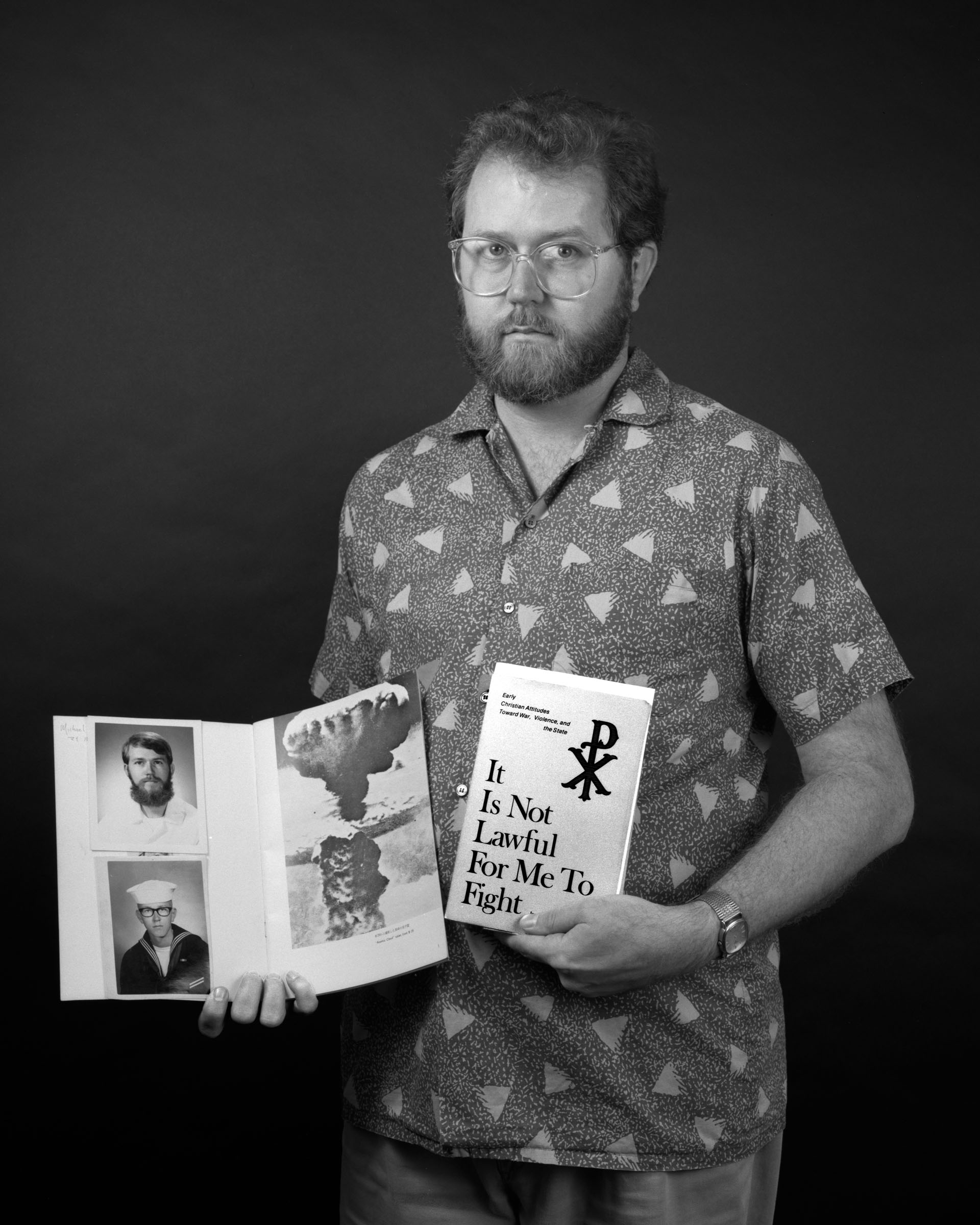
I had been a seminarian in high school, planning to become a priest. But in the summer of 1970 I was suddenly a man without a deferment, and I knew my draft board wouldn’t accept the CO thing. The draft meant definite combat duty, so my decision came down to, do I join the Air Force or the Navy? Of the two the Navy seemed more exciting. Also I thought the closest I’d get to the war was on a ship way off the coast, and hopefully I wouldn’t be killing people.
During boot camp I was still, in my mind, a seminarian. The first chaplain I went to was a Navy captain, dressed in his white uniform. I walked in and he said, “Petty Officer Hovey, have a seat. What can I do for you?” I said, “Well Father,” and he held up his hand and said, “I see you’re new in the Navy, so no problem, but you have to get used to this, you are a Petty Officer, I am a Captain. Now, Petty Officer Hovey, what can I do for you?” And I said, “Well, sir, I was a high school seminarian, I thought about the priesthood seriously, and to tell you the truth, I’m having some questions about some of the things I’m seeing.” And I said something like, “To be honest Father,” and he held up his hand and said, “No, no, no, you don’t understand. You are Petty Officer Hovey. I am a CAPTAIN. Now, go ahead.” So I stood up and said, “Sir, Captain, I’m sorry, I seem to be wasting your time. I came in to talk to a priest,” and I walked out. That was the last day I set foot in a church for almost the entire time I was in the Navy — until the CO thing happened.
I was assigned to Japan at the end of 1973. There wasn’t much to do in the area; the one place nearby was Nagasaki. It was a good day trip. Every time we went to Nagasaki, I went to the Peace Park to visit the museum. The first time I went I had been practicing in Japanese how to say “I am an Englishman,” instead of “I am an American.” I was very anxious about it; not so much about being attacked or anything, just about being recognized as an American and feeling looks of hatred. People were just breaking down and crying all over the place. After I turned in the papers for conscientious objection, I said to a couple of Japanese people, “It’s because of what I’ve seen and because I feel so terrible about being implicated in it by virtue of being an American citizen and a military man, that this is my way of saying I’m sorry and it won’t happen again.”
When I filed for CO, the war had been over for just a couple of months. I didn’t leave the Navy because of Vietnam, on the other hand, Vietnam was also the specter hanging over everything; whether it was sending people to it or treating them, or talking with them when they got back. In a funny way, the Navy itself is more responsible for me becoming more of a strict pacifist, expanding my opposition to all war. The Vietnam War was more or less just my reference point: what I knew about it, I didn’t like and I didn’t think it was right for us to be involved. The fact that the regulations don’t permit objection to a particular war forced me to think about why I would be opposed to the Vietnam War, but not another one. If I say the reason is I don’t want to be involved in killing personally, and I don’t want other people to be involved in it. So really the Navy regulation did more than reading the New Testament to get me to a point of being an absolute pacifist.
Archived Material
No posts
Podcasts
No posts