BONUS EPISODE: First Person with Bill Short, Part 1
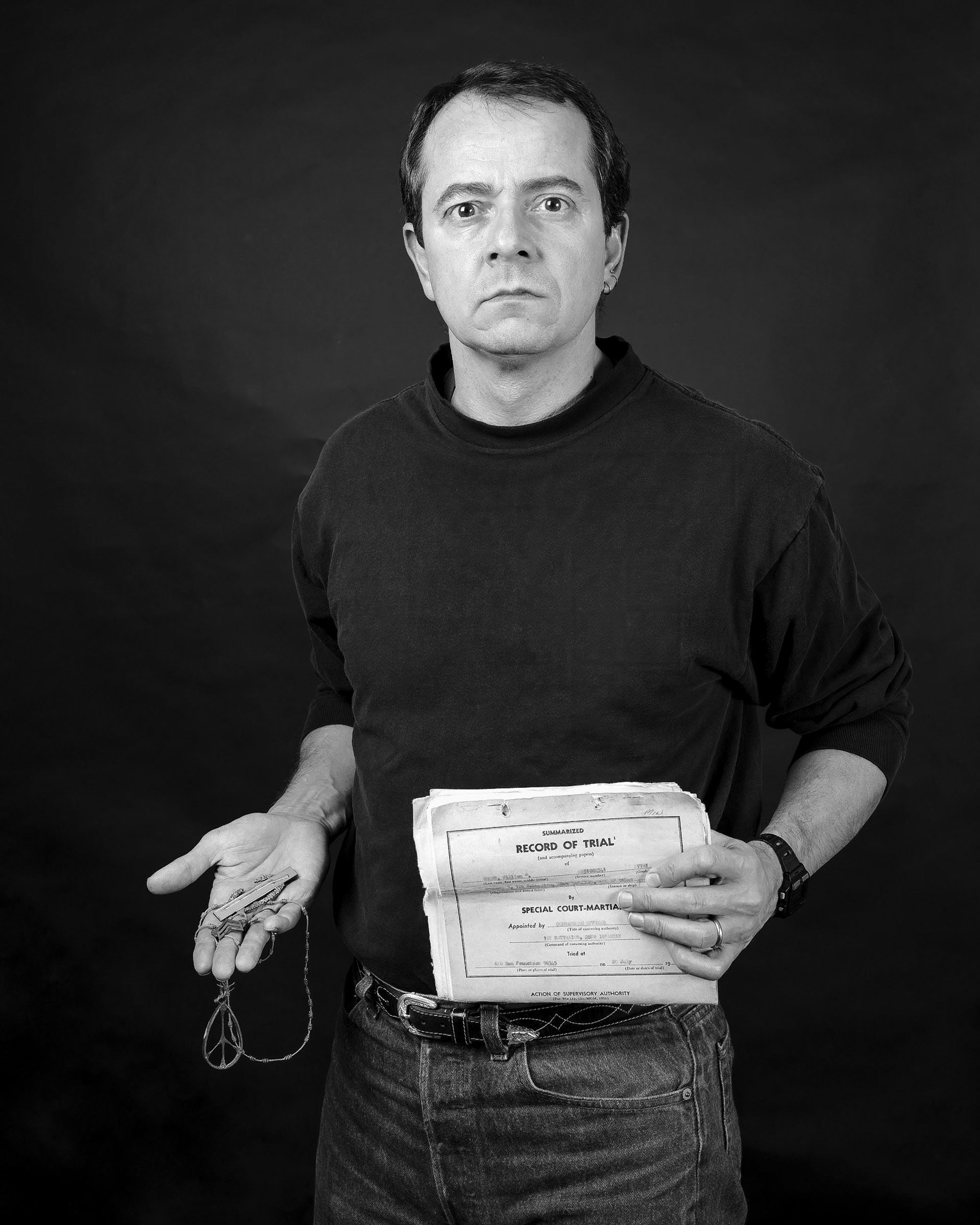
Throughout the podcast A Matter of Conscience: GI Resistance During the Vietnam War, you’ve been hearing snippets of co-host Bill Short’s story. Now, we bring you three Bonus Episodes that take Bill’s story from start to finish: growing up in a family with generations of military veterans, being drafted, Army training, combat in Vietnam, the moment that led him to stop fighting, and the homecoming that came with its own battles. These episodes were culled from six hours of interviews conducted by co-host Willa Seidenberg and associate producer Polina Cherezova.
In Part 1, Bill shares his personal evolution from a conventional, middle-class upbringing in Ohio to the front lines of the Vietnam War. It sets the stage for Bill’s ultimate refusal to continue combat operations in Vietnam.
Listen to this episode and explore the full podcast series on the A Matter of Conscience website.
Songs:
- “I-Feel-Like-I’m-Fixin’-to-Die Rag” – Country Joe McDonald – 1967
- Drafted – Wilbur Harrison – 1961
Listen to A Matter of Conscience:
Follow A Matter of Conscience:
Website: https://amatterofconscience.com/
BONUS: First Person with Bill Short, Part 1
Willa Seidenberg 00:04
Welcome to a bonus episode of the podcast “A Matter of Conscience: GI Resistance During the Vietnam War.” I’m Willa Seidenberg.
Willa Seidenberg 00:13
Throughout this podcast, you’ve heard my co-host and husband Bill Short talk about some of his Vietnam experiences — as a draftee, a soldier in the army, a war resister, and a veteran. In these next three bonus episodes, we’re bringing you more of Bill’s story in his own words. These episodes were culled from six hours of interviews conducted by me and our associate producer Polina Cherezova. And a warning: you’ll hear profanity and references to drug use.
Willa Seidenberg 01:23
Hey Bill, I want to take you back in time.
Bill Short 01:27
Okay, but do we have to?
Archival Sound 01:30
There were repeated comments of long overdue, long overdue, as the Vietnam Veterans Memorial was dedicated in Washington today, and thousands of Vietnam veterans marched on Constitution Avenue.
Willa Seidenberg 01:41
So when the Vietnam Veterans Memorial was dedicated in Washington D.C., that was 1982, we were living in Yellow Springs, and you had pretty strong feelings about that memorial.
Bill Short 01:55
I did. I really opposed any memorial to the war because I thought the war was criminal. I thought my participation in the war was criminal. I thought that all these vets wanted was some way to justify that the war was okay and to whitewash their conscience. I thought we were all guilty and we all should be ashamed of our service in Vietnam.
Willa Seidenberg 02:17
And we had some pretty heated arguments between us because I was trying to defend the veterans, saying, “Well, they were uneducated; they didn’t know.” And you got really hot about it.
Bill Short 02:32
I did, because it’s true that there are many of us who went naively and were very unaware politically of what the stakes were in Vietnam, but there were a lot of guys I knew in Vietnam who were gung-ho. I couldn’t stand the right-wing politics of the war. I couldn’t stand the right-wing vets that I ran into. Some of these guys were real fascists, and they treated the Vietnamese brutally, and they were disrespectful to the women. I thought that the whole essence of the Vietnam War was going to be whitewashed by the Right, and indeed, even though Maya Lin was the appropriate person for it, I’ve come to really believe that that feminine wedge in the ground is the appropriate memorial. What I really hated about it was the addition of those three walking soldiers in full combat uniform that they added afterwards.
Willa Seidenberg 03:23
That was 1982, and at that point, you hadn’t really talked a lot about your experience, and you hadn’t done it publicly in the way that you did later on.
Bill Short 03:34
So the reason I didn’t talk about my Vietnam experience was because I was so angry about it. I was so angry about how it fucked up my life for 10 years after the war, but when I started considering my experience publicly, that’s when I started going to school to study art. I started doing these paintings, and my painting instructor said, “These things are pretty dark. Where are they coming from? They’re abstract, but they’re coming from somewhere.” And sure enough, you know, they were coming from my anger and my memory of the war.
Willa Seidenberg 04:16
At that point, you did not have any connection with a peace veteran’s community, which came later when we moved to Boston, and then you ended up going to the memorial and visiting it with some other vets.
Bill Short 04:34
Yeah, I went there with 50 other guys from the Smedley Butler Brigade when we went to support the Fast for Life that Charlie Litkey and Brian Wilson and some other guys were doing. They fasted on the Capitol steps against the incursion into Central America, Reagan’s politics in Central America. So yes, I did go there, and I did come to embrace the memorial primarily because of the artist who.
Willa Seidenberg 05:02
One of the very first times that I heard you tell a very difficult story was not long after we got married. We went to Baja for a vacation, and we were staying at the Rosarito Beach Hotel, and we were having dinner, and it was Easter Sunday, and I’ll never forget sitting in that restaurant and you telling me about being pinned down during a firefight in Vietnam on Easter Sunday. So over the years, those stories were coming out continually, but for years, I’ve wanted to sit down and have you tell your entire story, and we did that in the course of doing this podcast. And I’m really happy that we finally have all of that in one place. But I wondered how it felt for you to do that.
Bill Short 06:05
Well, it was hard. I guess that’s why we didn’t do it over the years. You know, like I can have little bits and pieces and spurts of outbursts about the history and about what I went through, but to sit down and tell the whole thing from beginning to end, just seemed so laden with bad memories and ill feelings and anger that I just didn’t want to go that far. But I also was torn because I felt like it was an important story that I wanted our son Sam to know because my dad didn’t talk about his experience.
Willa Seidenberg 06:54
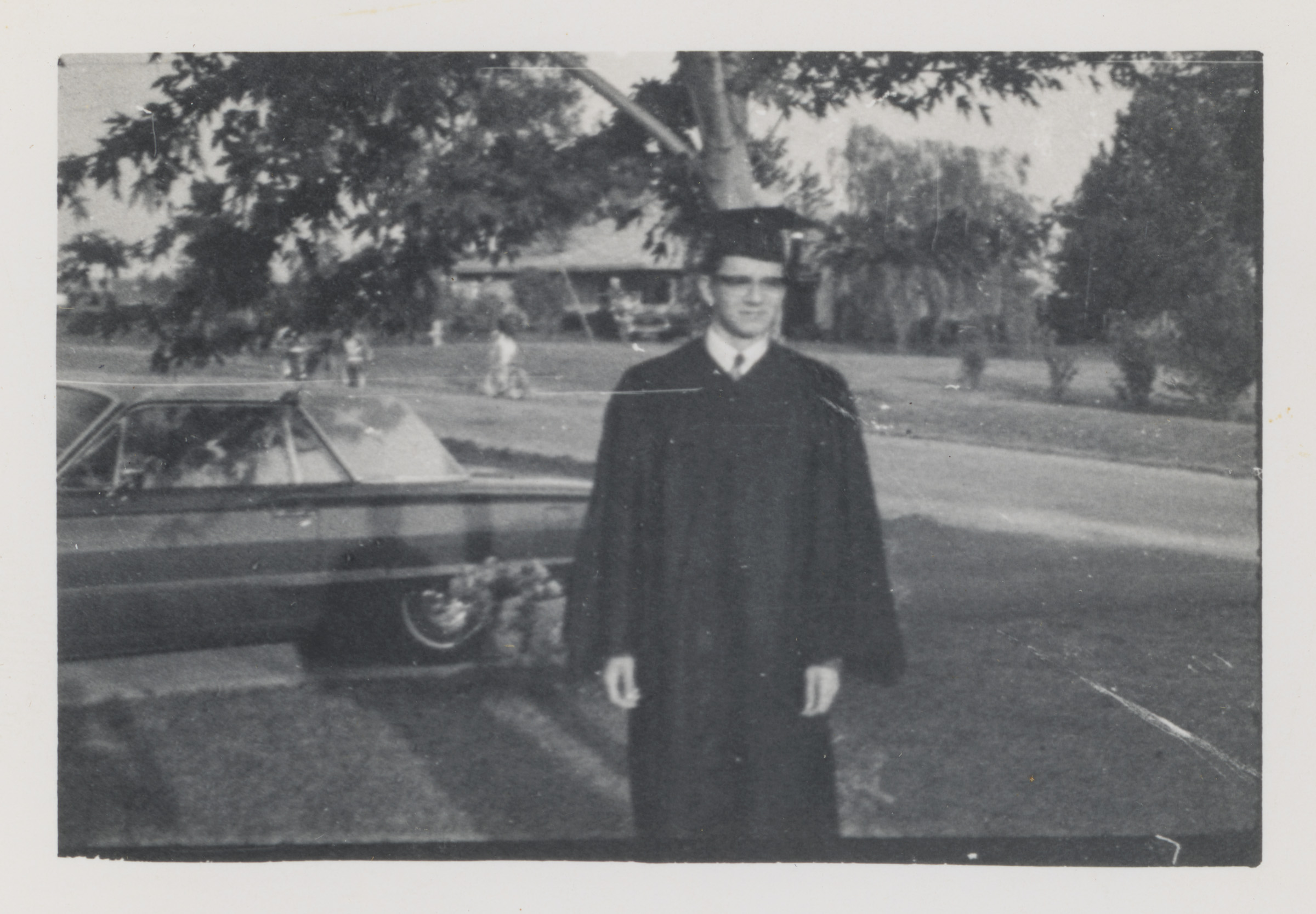
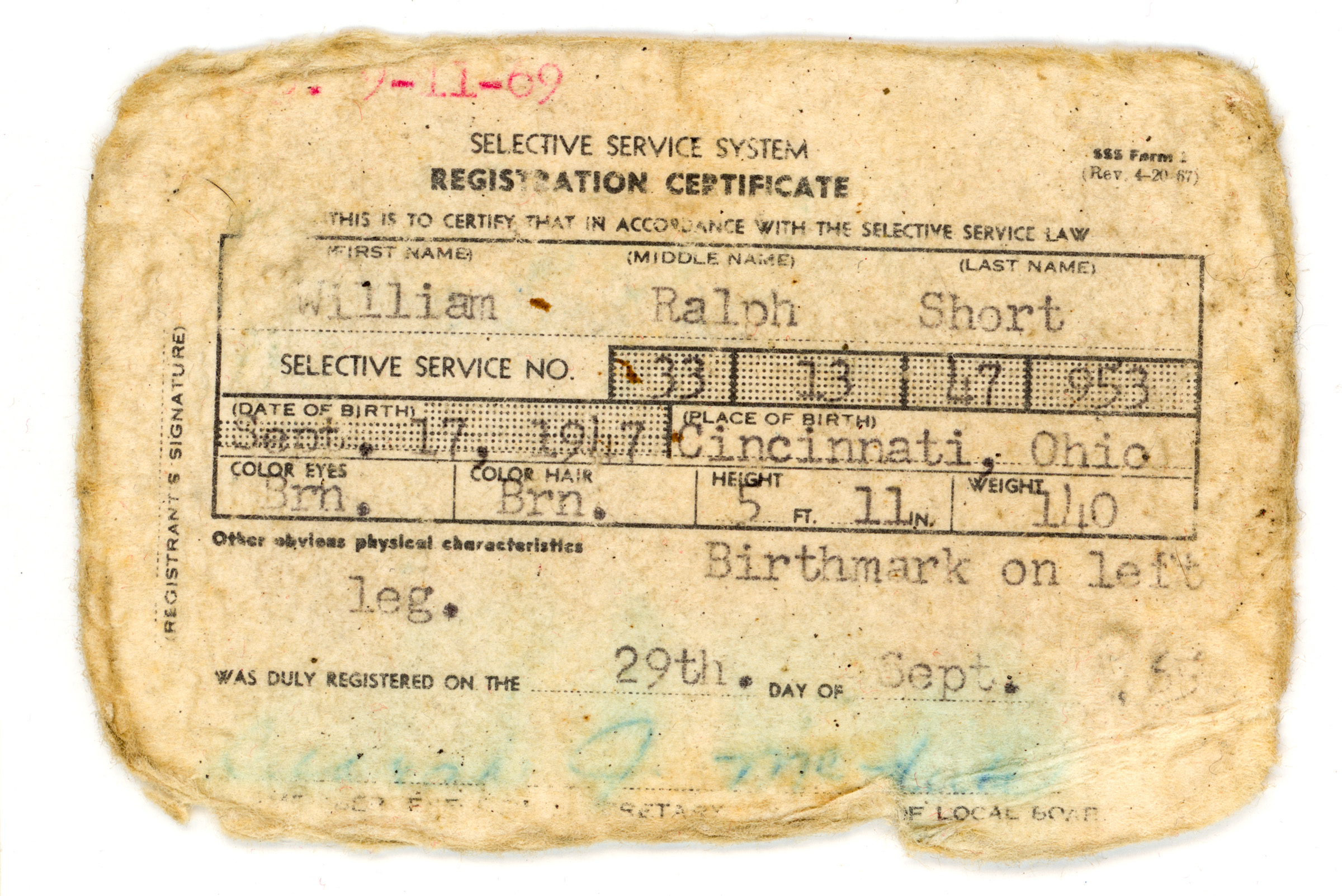
So we’re going to start at the beginning. Bill was born in September of 1947. He mostly grew up in a middle-class suburb of Cincinnati, although his family did move around a little bit. He had his parents and two younger siblings, a sister and a brother, and it was a fairly typical 50s upbringing.
Bill Short 07:22
My dad was a veteran of World War II, U.S. Navy. When Pearl Harbor happened in December ’41, his ship was moved to the Pacific. His ship had been kamikazed, and he spent several hours in the Pacific, floating around with a head wound. He had a Purple Heart that I would always kind of sneak into his bedroom and take a look at because it always seemed kind of magical to me. He had an engineering position at General Electric in Cincinnati. He was working on guidance systems for a B-52 bomber.
Archival Sound 07:56
B-52s could carry up to 27 and a half tons of bombs. The B-52s joined the tactical air war, bombing Viet Cong positions, supply routes, and staging areas.
Bill Short 08:07
My aunt had some sort of security job at Wright-Patterson Air Force Base. She encouraged my dad to apply for an engineering position with the Air Force, but since he didn’t have a bachelor’s degree, they made him take an entrance test. According to my aunt, he got one of the highest scores that ever been recorded on that test. So he went to work for Air Force Intelligence, a group called Foreign Technology Division. My dad specialized in microwave communications, radar systems. He was analyzing Russian guidance systems. It was a high-security job. He would periodically be gone for two, three weeks at a time, and we had no idea where he would go. He went to Vietnam two or three times during my high school years. Up until Tet of ’68, we weren’t allowed to be within, from what I understood, 50 miles of a Soviet border. I guess they worried that there would be a threat that agents would kidnap somebody in our family and then use that as leverage against my father. But when Tet of ’68 happened, a lot of those personal deferments disappeared. And I know when I got drafted, my mom told me later that my dad actually went to the Secretary of the Air Force to try to intervene and make sure that I didn’t get assigned to Vietnam. But I guess that never panned out because I ended up going anyway. So, the neighborhood that we ended up moving into was near Wright-Patterson.
Archival Sound 09:48
Welcome to Wright-Patterson Air Force Base, one of the largest and most diverse U.S. Air Force installations.
Bill Short 09:55
There’s a very large percentage of people in my neighborhood who were Air Force officers. John Glenn lived in my neighborhood. You know, a lot of my friends, you know, were Air Force brats. You know, my high school was a really, really white high school. I mean, there were two Black kids and two Jewish kids in my high school, and that was it. Very conservative area. My first semester at Ohio University after I graduated high school was in the fall of 1965.
Archival Sound 10:29
To get to be an Air Force pilot, first you have to be an Air Force officer.
Bill Short 10:34
And I joined Air Force ROTC, Reserve Officer Training Corps. I primarily decided to join because of my dad’s influence and my family’s influence, and because of our long military history of service to this country.
Archival Sound 10:48
Many colleges and universities now offer a two-year Air Force ROTC program.
Bill Short 10:54
So I had my little blue uniform, and I’d go to ROTC classes and learn how to salute and march. And I remember the first demonstration that ever went to. I actually carried a sign calling for the bombing of Hanoi because it was a counter-peace demonstration that my ROTC group went to. And then after I did it, I think I started thinking about, well, why did I do that? After the first semester, I dropped out. I decided to quit because I quickly realized that I didn’t like the way the command structure worked. I didn’t like taking orders. I didn’t like somebody telling me what to do without thinking about it and considering why am I going to do this. And the Air Force and all military are not about questioning orders; they’re about following orders, no matter what the consequences are. Just because you’ve been given them. And the more I questioned the orders that I was getting, the more I realized I didn’t want to be Air Force ROTC. I didn’t want to be in the military at all. Also, I kind of felt weird and embarrassed wearing that blue uniform on campus because there was some anti-war activity happening, and you know, I wasn’t anti-war at the time. I didn’t even understand what Vietnam was about. I didn’t even know where Vietnam was. So by the time I was a sophomore, I was totally counterculture.
Archival Sound 12:24
Because the 60s was the moment in history when young people took over society, culture, and the media, and expressed all their values and their interests. This revolutionary fervor, this desire to overthrow the world.
Bill Short 12:42
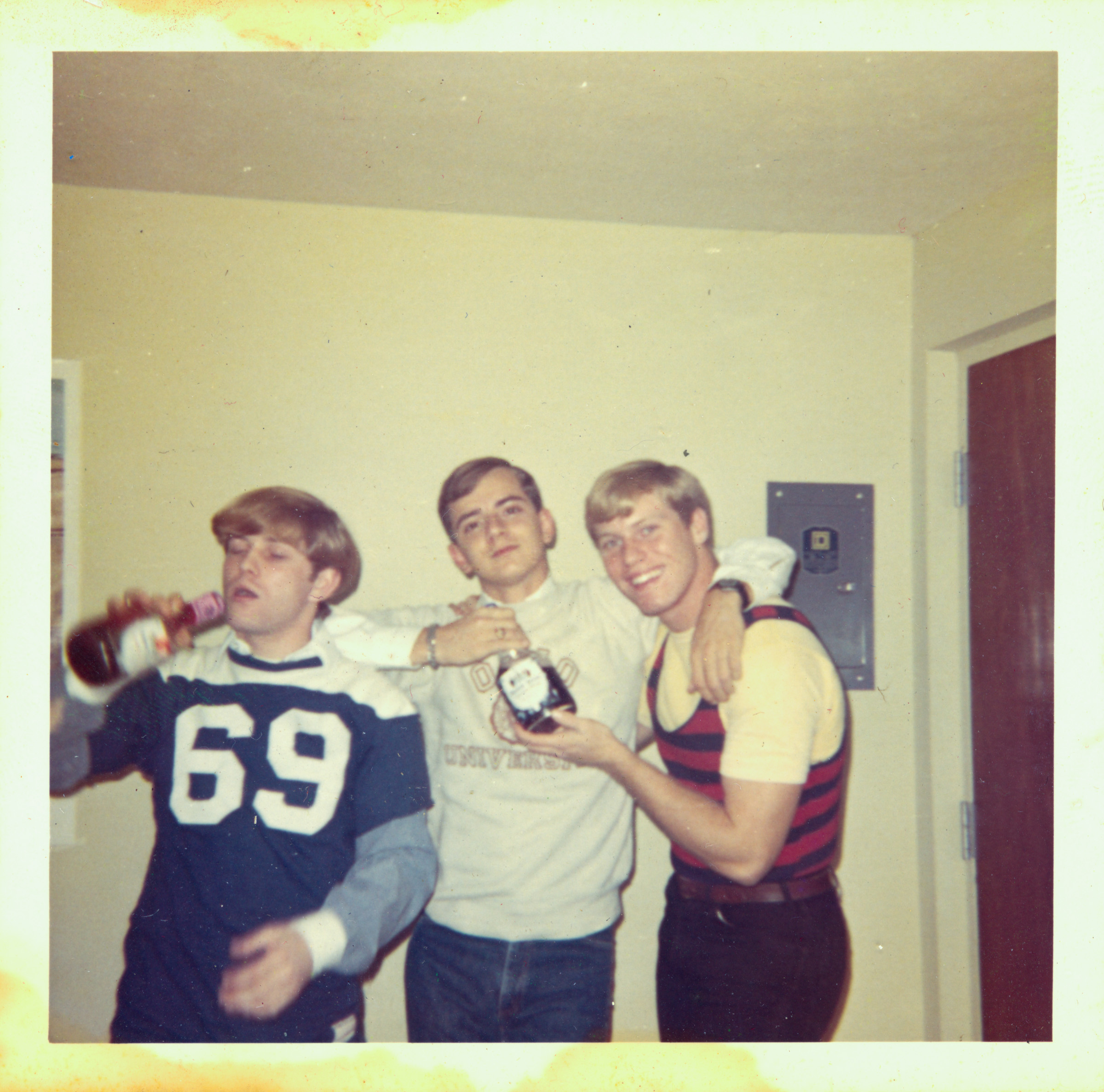
Friend of mine, Ira Cohen from Brooklyn, New York, introduced me to smoking pot, and so from September of 1966 on, I was smoking as much pot as I could. I was on this kind of road of kind of introspective discovery. That’s why I think I was attracted to the music of the day because a lot of the music of the day was about discovery, and that’s why I was interested in doing drugs, is because it put my head in a different place, a new environment. I took an econ class, and the econ professor was rabidly anti-war in Vietnam, and he made it known in his classes. And that was one of the classes I liked because I liked what he was saying, but I wasn’t ready to act on any of it.
Bill Short 13:40
My freshman year, I was wearing button-down shirts that I took to the laundry and had them starched so the collars would stand up high. I was wearing penny loafers and cuff slacks, and you know I was a real kind of classic collegiate-looking kid. By the following year, I took those penny loafers and a razor knife and cut them up to look like sandals. My hair was getting long, wearing blue chambray work shirts, and I dug out my dad’s old pea coat. I looked like I belonged on a Bob Dylan cover.
Bill Short 14:17
I got suspended for a semester because of my grades. Then got reinstated in the fall of 1967, but I had no interest in being in school. By the end of 1967, I got suspended for good. Three months later, March 12th of 1968, I got drafted.
Bill Short 14:56
You know when you’re that young, when you’re 19 years old, you feel invincible, and you feel like nothing bad’s ever going to happen to me. And then when I did get drafted, I thought, you know, I’ve got two years of college, even though it was two bad years of college. I figured that I might end up in Germany as a clerk typist and be closer to a source of hash. So, it wasn’t like I was thinking very clearly.
Archival Sound 15:26
The military draft brought the Vietnam War to the American home front. Between 1964 and 1973, the U.S. military drafted 2.2 million American men.
Bill Short 15:38
In March of 1968, I was drafted through the Clark County Draft Board in Ohio. Previous month in 1968, in February, there were about 30 people who were drafted. But right after Tet happened in ’68, in March when I was called up, there were over 150 of us, more than quadrupled in that short length of time. This draft board was one of the most hostile and one of the most vicious run draft boards in the entire country. In fact, it was so bad that Look magazine did a whole article on the draft board.
Bill Short 16:17
They swear you in, and you’re supposed to take a step forward; it signifies your step into the new life of being military service. So, everybody else took the step forward, and I didn’t. But nobody noticed. I guess this was my first act of resistance. I thought that if I didn’t take the step forward, that I wasn’t actually committing to being in the military. A woman ran the draft board in Clark County, which was kind of unusual. This woman, when we got on the buses to go, she stood at the bus, and as we each got on the bus, she gave us a copy of the New Testament, and just said, kind of nastily saying, “Good luck in Vietnam, because that’s where you’re going.” So, the bus took us to a plane, and I had never flown in a plane before, and I ended up on this small plane going to Columbia, South Carolina, at Fort Jackson, and that’s where I went to basic training.
Bill Short 17:31
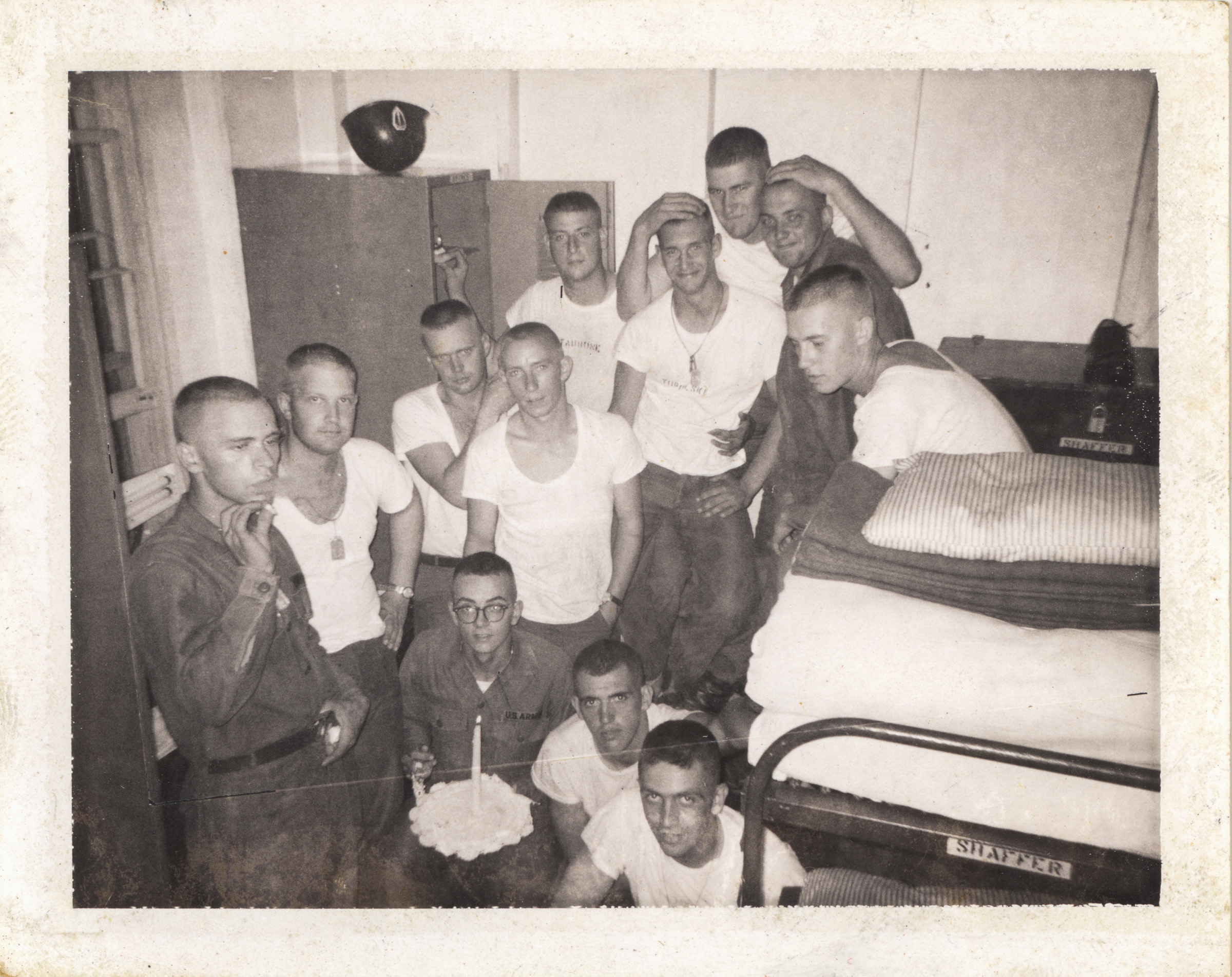
I remember standing in this line, and my hair was you know long, and being harassed by all the sergeants around there. You know they pick on anybody who had long hair. They shave all your hair off, and there’s like three or four or six barber chairs, and they’re just running us through buzz cut. And when I sat down, two sergeants stood on either side of me, calling me, you know, queer, pussy, faggot, peacenik. Then when we went outside and we were standing in a group like in a formation, my feet were like a couple inches apart, and some sergeant came up and stuck his mouth right in my ear, and screamed at me, and then kicked me as hard as he could in the feet and said, “Get those feet together, soldier!” That’s when I knew I was in deep shit.
Bill Short 18:23
They would stand you at the bottom of your bunk. So, I’m standing there at the position of attention. The sergeant was going down the line, harassing everybody, yelling things at everybody like, “You think you should kill somebody? You think you can pick up a gun and shoot somebody? Shoot an enemy soldier?” And I don’t know why I did this, but I got into this long philosophical rap about how would anybody ever be able to know if they were capable of killing another human being until they are actually faced with the problem of having to do it. I remember them staring at me with these blank, shocked look on their faces, and the sergeant finally said, “You think you’re a fucking lawyer? You’re nothing but a shit bird.” And it went all downhill from then, because you know, like I’d open myself up as being this pansy intellectual, and so from there on out, they made sure to make my life miserable. And I was also small and scrawny and wore glasses. I resolved, since I was physically fit, strong for my size, that I was not going to let them beat me. So, whenever there was a physical task to do, I did it to the nth degree. I think by the end of basic training, they figured out that they weren’t going to completely break me.
Bill Short 19:46
One of the things that happened toward the end of basic training is we’re going to have an inspection the next day, and we’re also going to have a physical training test. I was overdue for a haircut. There’s a base beer hall, and there’s a barber shop nearby. So, I left with two other guys, and we skipped chow line because we all needed haircuts. We knew we’d get dinged if we didn’t get haircuts. So we went to the beer hall to get pizza. That night we’re laying in our bunks at about nine or 10 o’clock, just about ready to go to sleep. They call out a company formation. Each platoon is standing in position of attention, and they announce that there had been a fight at the beer hall, and somebody had been stabbed in the fight. So, they wanted to know who the fuck in our company had gone to the beer hall. Three of us are like going, wasn’t me, wasn’t me, you know. So they said we’re going to find out which one of you cocksucking motherfucking shit birds went to the beer hall.
Bill Short 20:58
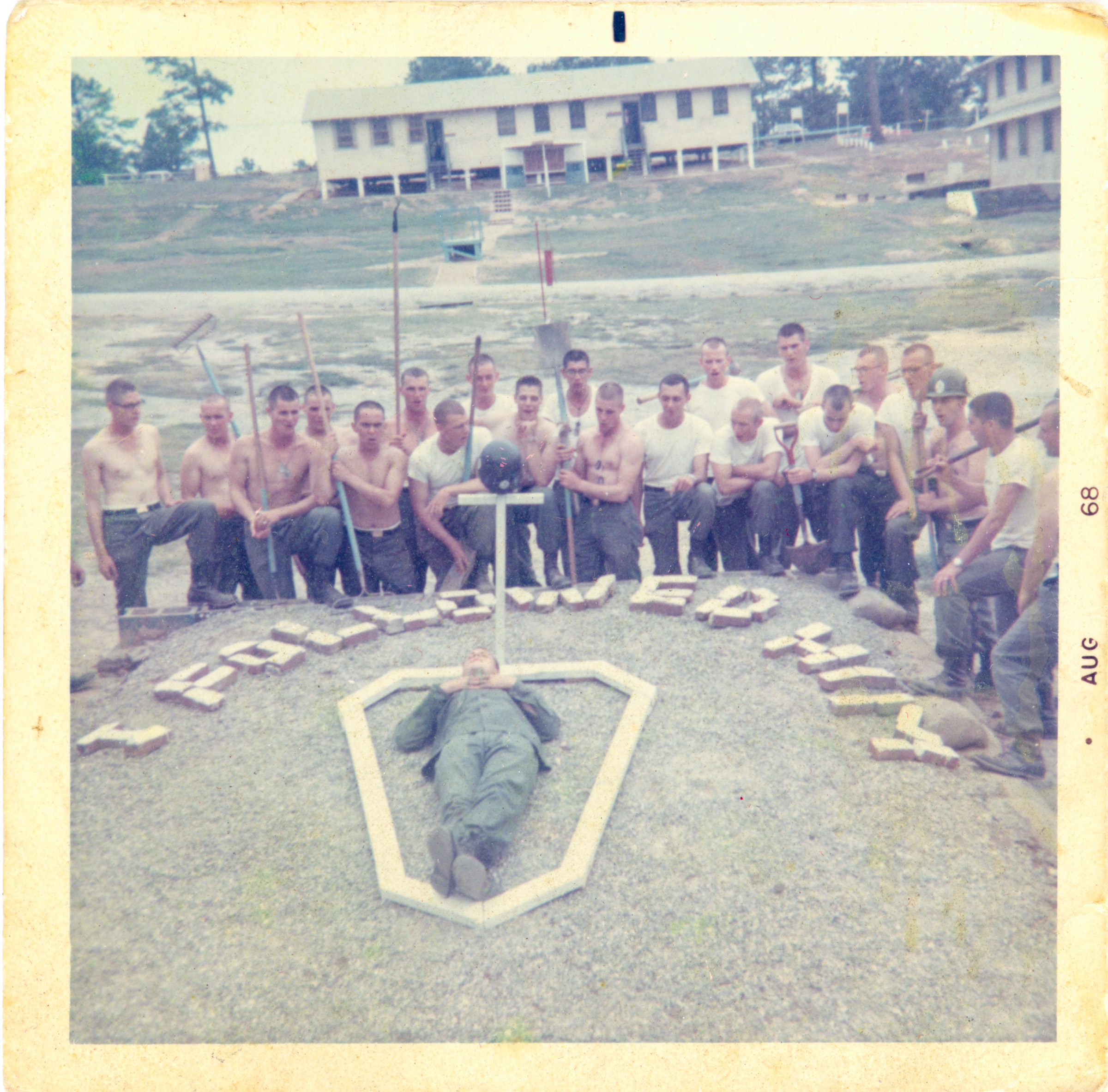
In South Carolina, all the barracks are raised up about two feet off the ground on pillars. So what they do is they line you up in rows by platoons, and they make you low crawl under the barracks. They did that to the whole company over and over and over again. Then they had us all out in the middle of the street, doing what they call the dying cockroach. They ordered all of us to lay on our backs, and then we all have to put our hands and feet directly in the air. And as you slowly weaken, you curl up into this little ball. It’s kind of like a dying cockroach. After about an hour of that harassment, finally, the three of us fessed up and said we’d been to the beer hall, but we hadn’t taken part in the fight.
Bill Short 21:53
So Sergeant Bullock, who was this Cherokee Indian from Tennessee, decided that we needed punishment. He gave us all a shovel and said, “I want a six by six by six.” So, we all three of us spent the whole night digging a hole, six feet wide, six feet long, six feet deep. I got it dug, I went in and told Sergeant Bullock that the hole was finished. He went out and looked at it, took his cigarette, flicked his cigarette into the hole, and said, “Bury it.” So, then I buried the cigarette, got that done at about six in the morning, and then I had to fall into formation and then go take the PT test. I scored the second-highest score in the entire company. The only thing I didn’t score 100 points on was the mile run. I ran the mile in combat boots in six minutes and seven seconds, and to get a perfect score, you had to run under six minutes. At the end of basic, I got orders to go to AIT, which meant I was going to stay at Fort Jackson. I was just going to go to a different unit. And when I was leaving, Sergeant Bullock actually came out and said goodbye to me. He didn’t do that for everybody. He was tough, but he was fair.
Bill Short 23:33
So then I go to AIT, and AIT was like completely different. It was a modern compound. Our barracks were like college dorms. One of the first things that happened during orientation was we were in this big room, and we’re going to get this orientation about you know being in the infantry. And so there was this lieutenant who had just come back from Vietnam, who’s going to tell us all about what it’s like to be in Vietnam and you know everything, and then he starts showing his slides. Halfway through the slideshow, he says, “Now, here’s my favorite picture, and it’s this severed arm.” He said, “This is a gook arm.” He said, “I blew the arm right off that cocksucker.” Toward the end of AIT, they offered me Non-commissioned Officer Candidate School.
Archival Sound 24:26
In Vietnam, NCOs assume much of the burden of combat leadership. To train the large numbers of new NCOs needed for combat, the Army created the non-commissioned officer candidate course at Forts Benning, Knox, and Sill,
Bill Short 24:44
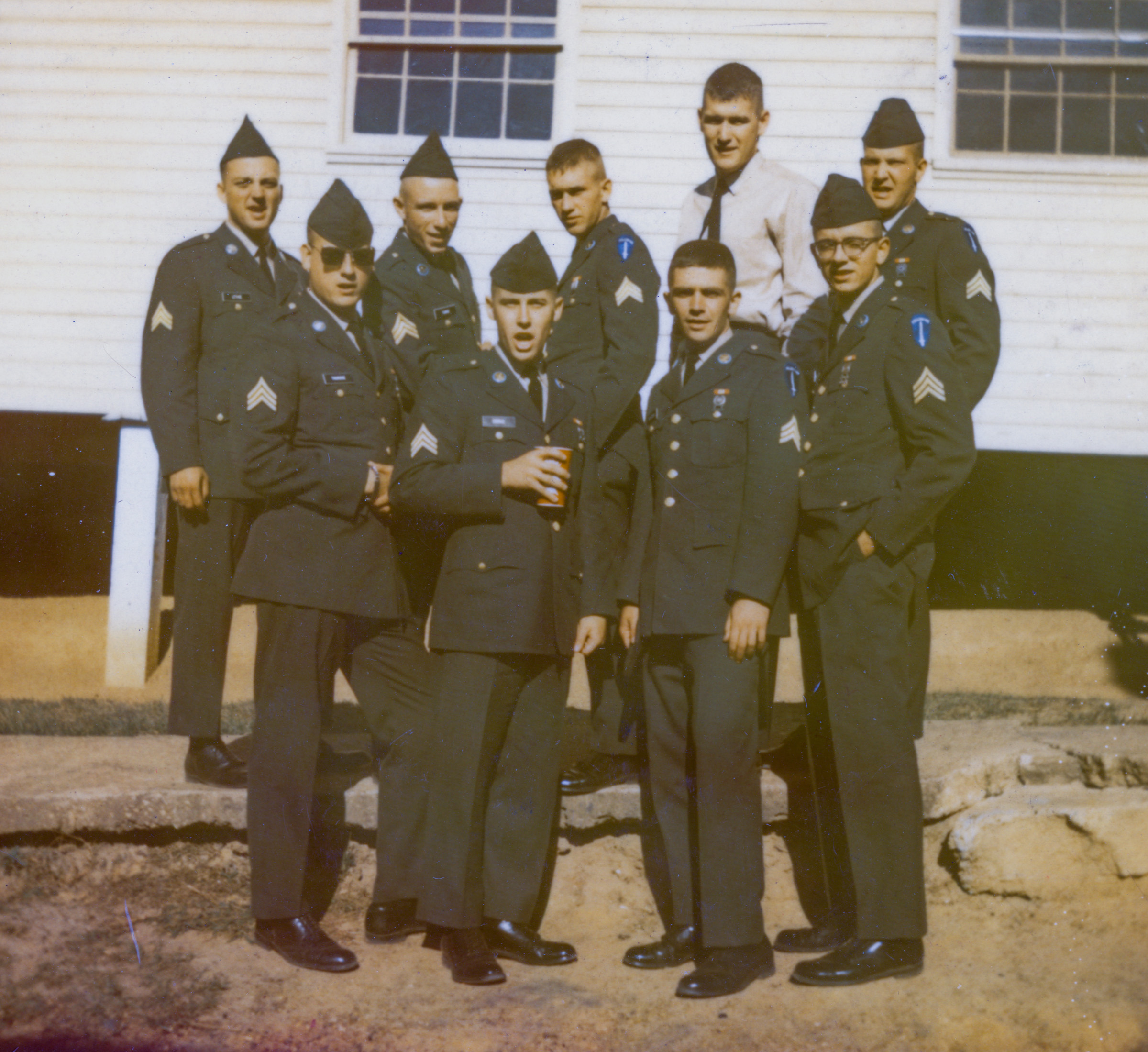
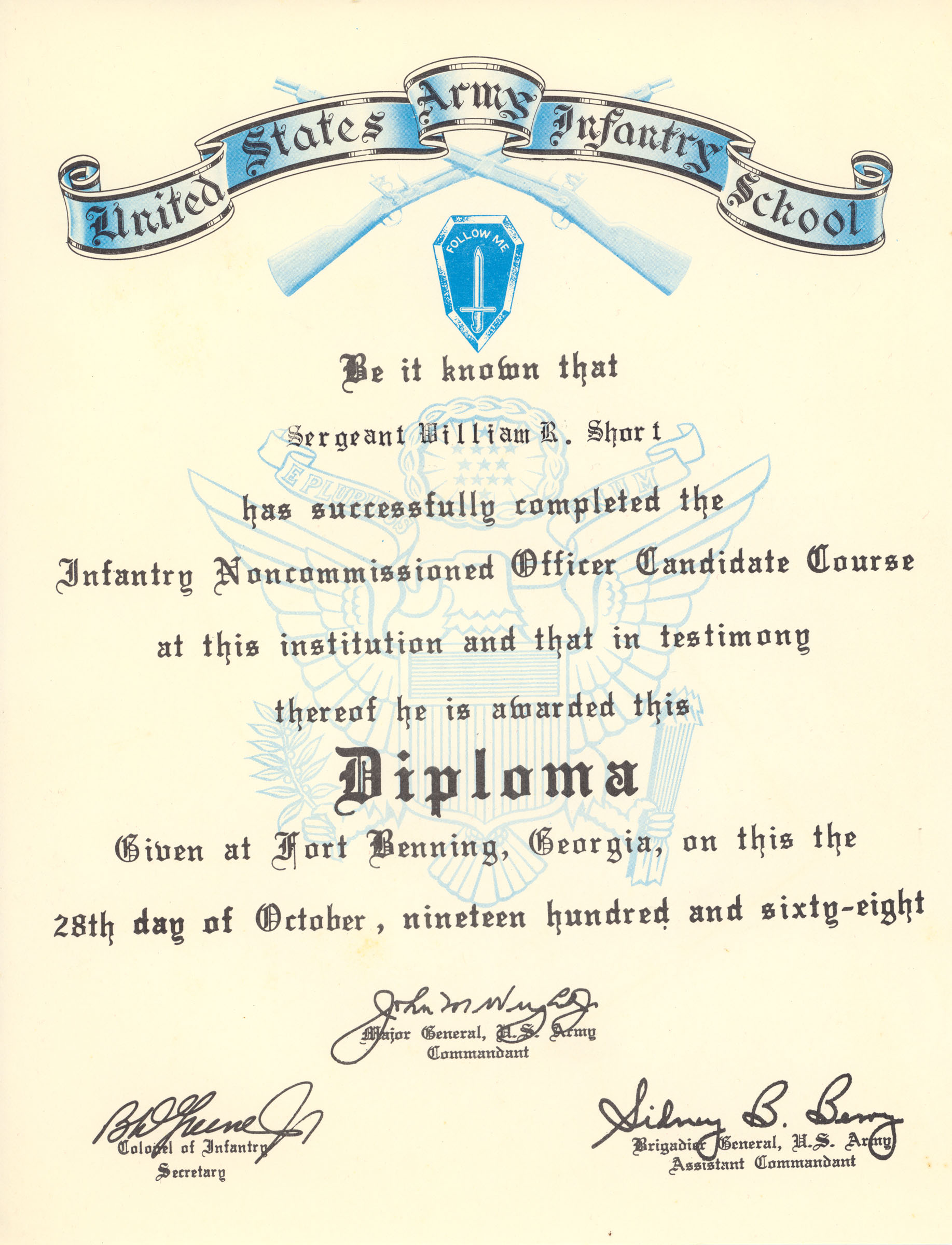
I decided to take the NCOC school not because I wanted to be a sergeant, but it was just 13 more weeks of training that would delay my time to go to Vietnam. And then I went to Fort Benning. So they would just work us to death. We would run three miles with full packs, holding our M16s above our head. I mean, I swam rivers with full combat gear. I jumped out of helicopters. Then, when you graduate, you’re then sent to a basic training unit to work as basically a drill sergeant, what they call the turtle hat. Drill sergeants get to wear the four-pointed cornered hat, the round brown hat that you think of when you think of a drill sergeant, and turtle hats just wear a helmet liner. So, in the military, then they had a fiberglass helmet that fit underneath the steel helmet, and so you would wear that like a hat. It’s a way for you to physically learn how to use your authority and order other soldiers around.
Bill Short 25:58
I got in trouble for fraternizing with the trainees, so I had a record player, and I always kept this record collection of Beatles records and Rolling Stones and that kind of shit. And so I would play those, and some of the trainees would come up and hang out with me, and listen to music, and that was really against the rules. But I didn’t care. So, they took me out of the basic training unit, sent me to this thing called a FTX Field Training Exercise Committee. This is at Fort Lewis in Washington State. We were supposed to pretend like we were enemy soldiers, and then trainees would come out for a three-day bivouac, where they would come out and live in the woods and fire M16s with blanks and play war games. And so, we were supposed to ambush them, and then throw dummy grenades, smoke grenades, and stuff, and pretend like we were Viet Cong ambushing them. We were all kind of misfits. That’s why we all ended up being out there. We had this supply clerk because we lived out in the woods, they would bring us food, so he would also bring us drugs too. So we’d be out there smoking dope and playing war games. I was just like back in sixth grade playing war games, pretending like you’re a soldier, but there’s no harm.
Bill Short 27:25
One of our tact sergeants was a guy named Sergeant Jones. He’s another one of those guys like Sergeant Bullock, who was hard but fair. There’s one day when we were out on a training mission, we were taking a break and smoking cigarettes. And there’s ant hills everywhere, and so this guy was lighting matches and dropping them on this ant hill and watching the ants catch fire. And Sergeant Jones came over, and he was pissed. He said, “You’ve never seen anybody like I’ve seen get hit with napalm, and I don’t want to ever see you repeating what I saw in Vietnam with these ants. And that was kind of mind-blowing to me. When I left NCOC school, he came out and stopped me, and saluted me, and said, “Come home.” Knowing how he had reacted to that guy burning the ants, that he knew I was headed somewhere that was dangerous, and he actually cared about me. I think his service in Vietnam changed him dramatically, and in some ways made him more human.
Bill Short 29:01
And then after that, I got a 30-day leave, and then I got orders to deploy to Vietnam. So, I came home for this 30-day leave, had a new girlfriend, the best friend of my previous girlfriend, and I think this new girlfriend felt it was her patriotic duty to be my girlfriend because her friend had dumped me, and I was going to Vietnam. The night that I said goodbye to her, we spent the whole night lying in her parents’ den, snuggled up on the couch, listening to the moody blues over and over and over again, kind of depressing when you think about it.
Bill Short 29:47
And I went to Vietnam, February 5th or 8th of 1969. We land in Alaska, and we have to disembark the plane. And back then, you exited down a staircase to the tarmac. Then you walk to the terminal. We’re in jungle fatigues. We hit the tarmac in a snowstorm. Snow is blowing. It’s 10 below zero, and we run like crazy from the plane to the terminal to get warm, and then we get back on the plane. Then we fly to Tokyo. Same thing. It’s freezing cold, and I’m thinking the whole time, this is crazy. You know, I’m going there in this big orange plane. I’m going in this cold weather and these jungle fatigues. Going to this tropical country. It’s like this weird hallucinatory kind of trip. After we landed in Vietnam, and I got to the door to leave the plane, I got hit by this thick, warm, moist air that almost choked me. It was so thick I felt like I couldn’t breathe, like a hot blanket had just been wrapped around my head tightly. And then I looked out, and I saw this huge mass of people and trucks and the smell of diesel fuel. And I looked down the stairs of the plane to the tarmac, and I thought, “Holy fuck, I’m really here. This is Vietnam”
Willa Seidenberg 31:34
Coming up in part two of Bill’s story, Bill is sent to the notorious stockade Long Binh Jail.
Bill Short 31:44
And I think the army’s thinking was is that I would go there and be so freaked out by being there for that 30 days that I would come back and agree to go back out in combat.
Willa Seidenberg 32:03
This episode was written, edited, and produced by Willa Seidenberg with help from Polina Cherezova, who also did the sound design. Our associate producer is Dylan Purvis. Many thanks to the late Country Joe McDonald for permission to use his song as our theme music. Additional music in this episode is by Andrew Patinkin and Danny Seidenberg, and we also use some selections from the free music archives: Lee Rosevere’s “The Past,” “Night Cave,” and “What’s in the Barrel.” We thank the Kazan McClain Partners Foundation for their generous support. Our fiscal sponsor is the International Documentary Association. Thanks also to Denise Abrams, Bill Belmont, Jeremy Lindenfeld, and Sam Short.