Episode 13: War is Hell: In-Country Resistance Part 2
In this powerful episode of A Matter of Conscience, veterans of the Vietnam War bear witness to the unthinkable and reveal the moral courage it took to refuse complicity in an immoral war. From infantry soldiers surviving ambushes, to a military intelligence officer who risked his life to stop the torture of prisoners, to a whistleblower threatened into silence after reporting war crimes. These are stories of young men — barely out of their teens — confronting the darkest extremes of warfare.
We’ll also hear from two Vietnamese women, survivors of the My Lai massacre, whose devastating testimonies put a human face on a U.S. military atrocity that shook the world.
This is not a comfortable listen, but it is a necessary one to understand why many U.S. soldiers came to oppose the war they were fighting.
Check out the show notes.
Guests/Subjects
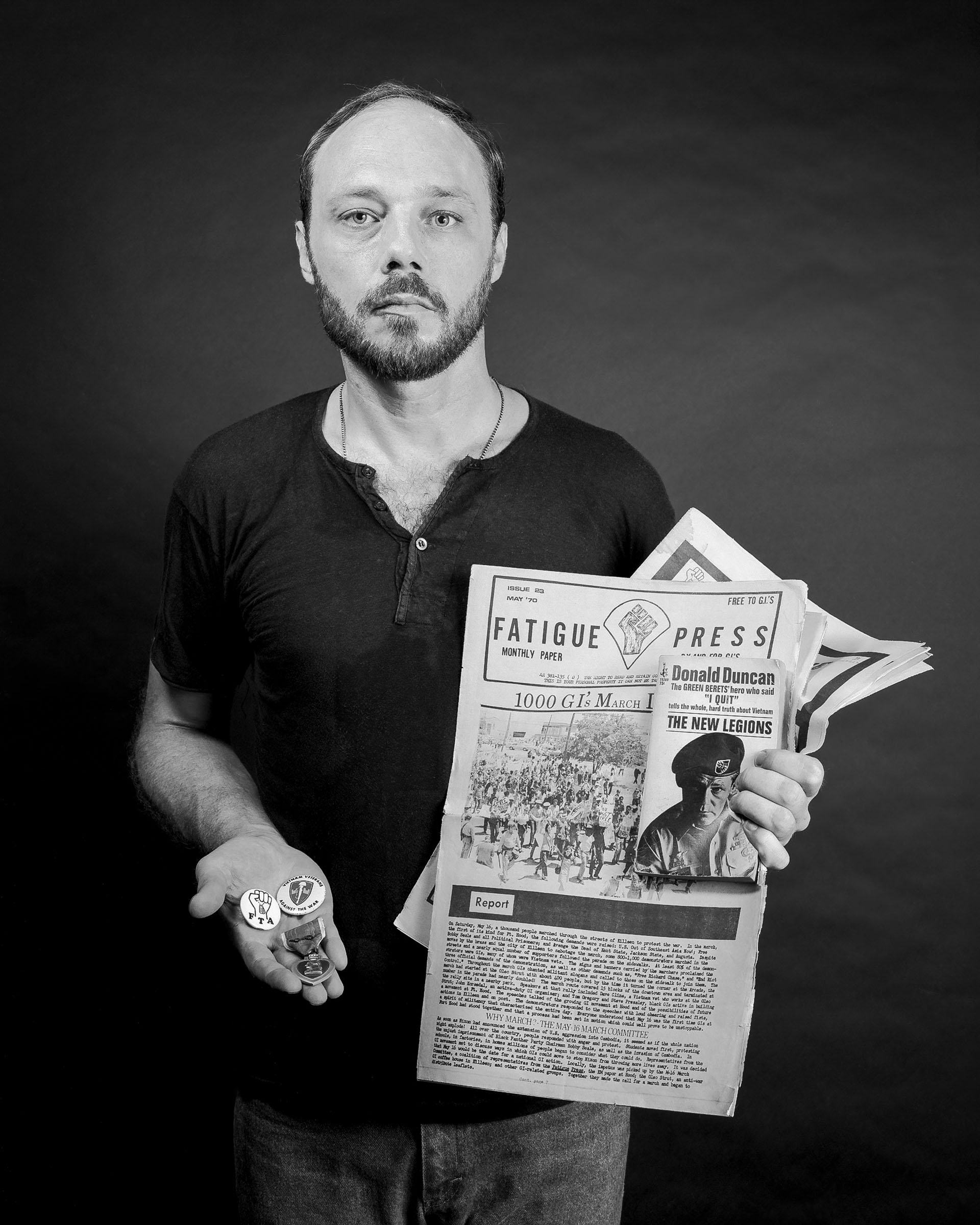
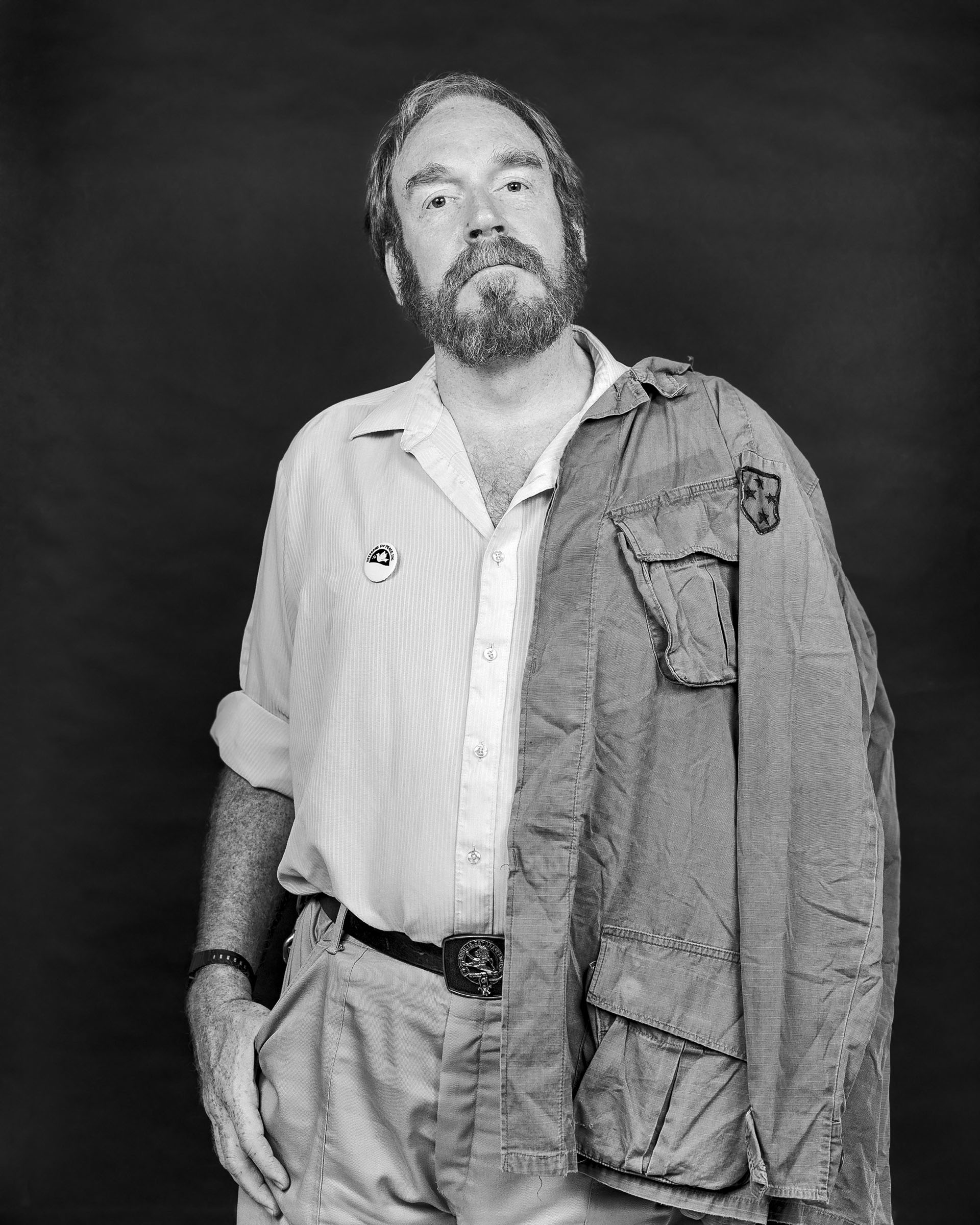
- Dave Cline: Drafted Army 19677-69. Served as a combat infantryman in Vietnam where he was wounded twice, receiving Purple Hearts and a Bronze Star. Became active in GI antiwar movement, helping publish Fatigue Press.
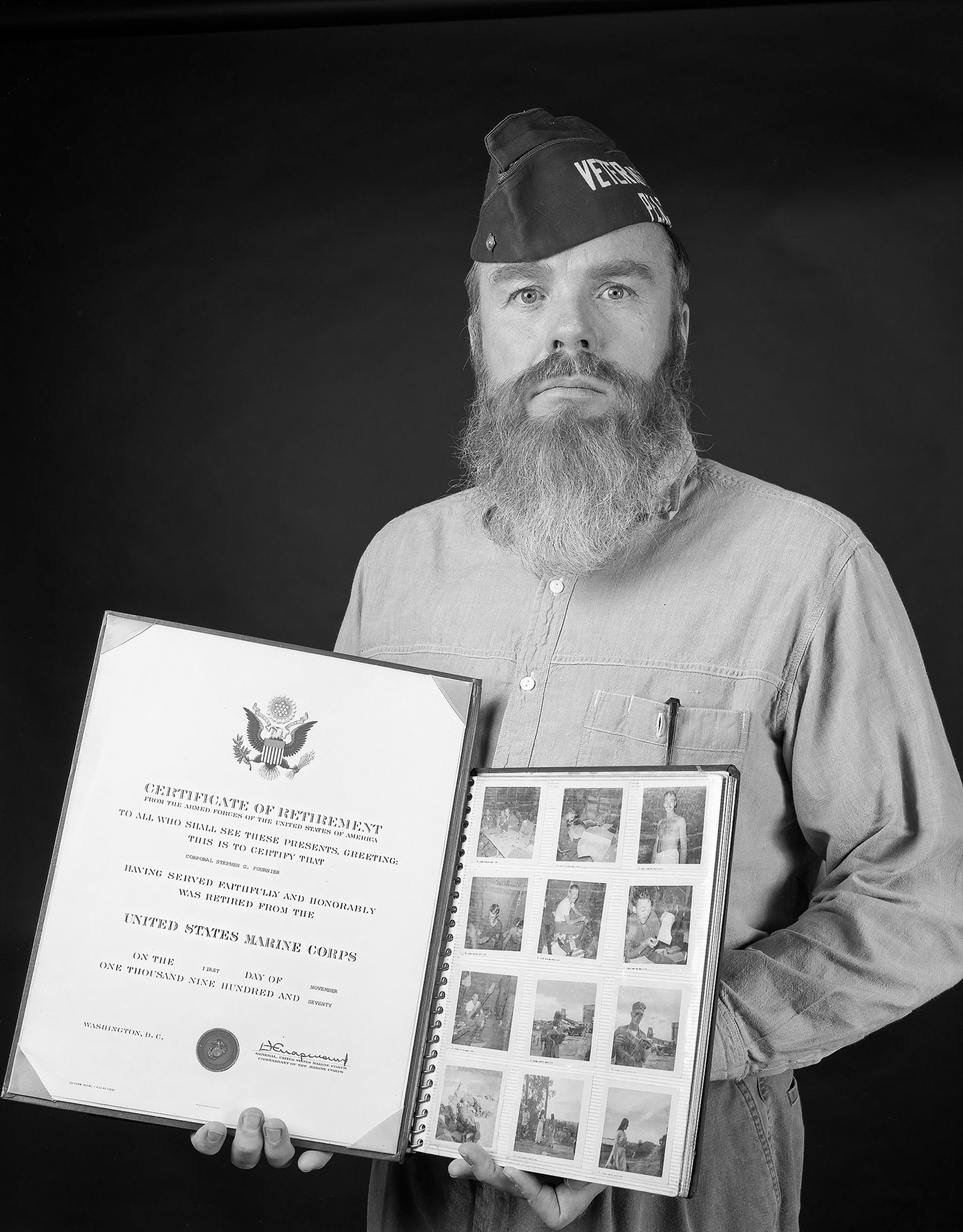
- Steve Fournier: Enlisted Marine Corps 1966-68. Served in Vietnam 1967-68. Wounded twice and given a medical retirement. Spoke at an anti-war rally in Boston two weeks before being discharged from the military.
- John Tuma: Enlisted Army 1969-72. Served in VN as an interrogator, trained in Vietnamese. Refused to torture VC prisoners.
- Ha Thi Qui: A survivor of the My Lai Massacre interviewed by Bill Short and Willa Seidenberg in 1994 when she was 69 years old. She was wounded in the hip and lay there quietly, underneath corpses. When she attempted to crawl home, she saw many injured people, including the bodies of women, some of whom had been raped and shot by U.S. soldiers.
- Truong Thi Le: A second survivor of the My Lai Massacre also interviewed in 1994 by Short and Seidenberg when she was 68 years old. She survived because she laid quietly underneath two dead bodies, but her six-year-old son who was with her was killed. In all, U.S. troops killed nine members of her immediate family including her husband, mother, three brothers, and a 17 year old daughter.
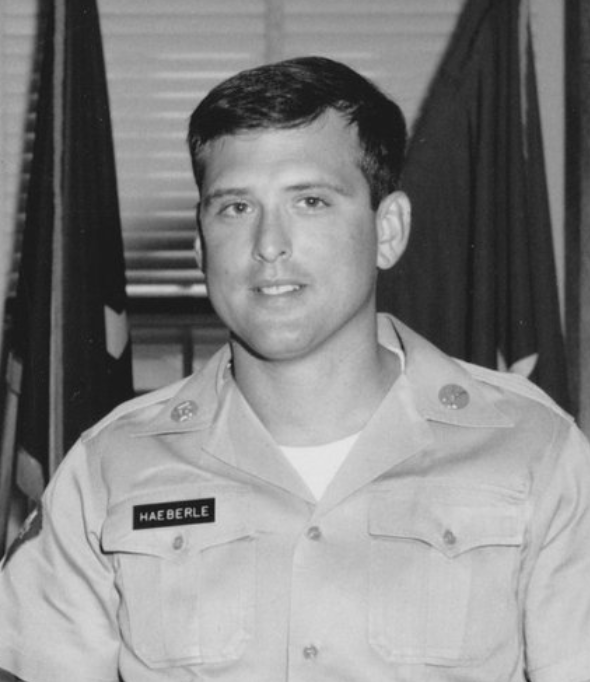
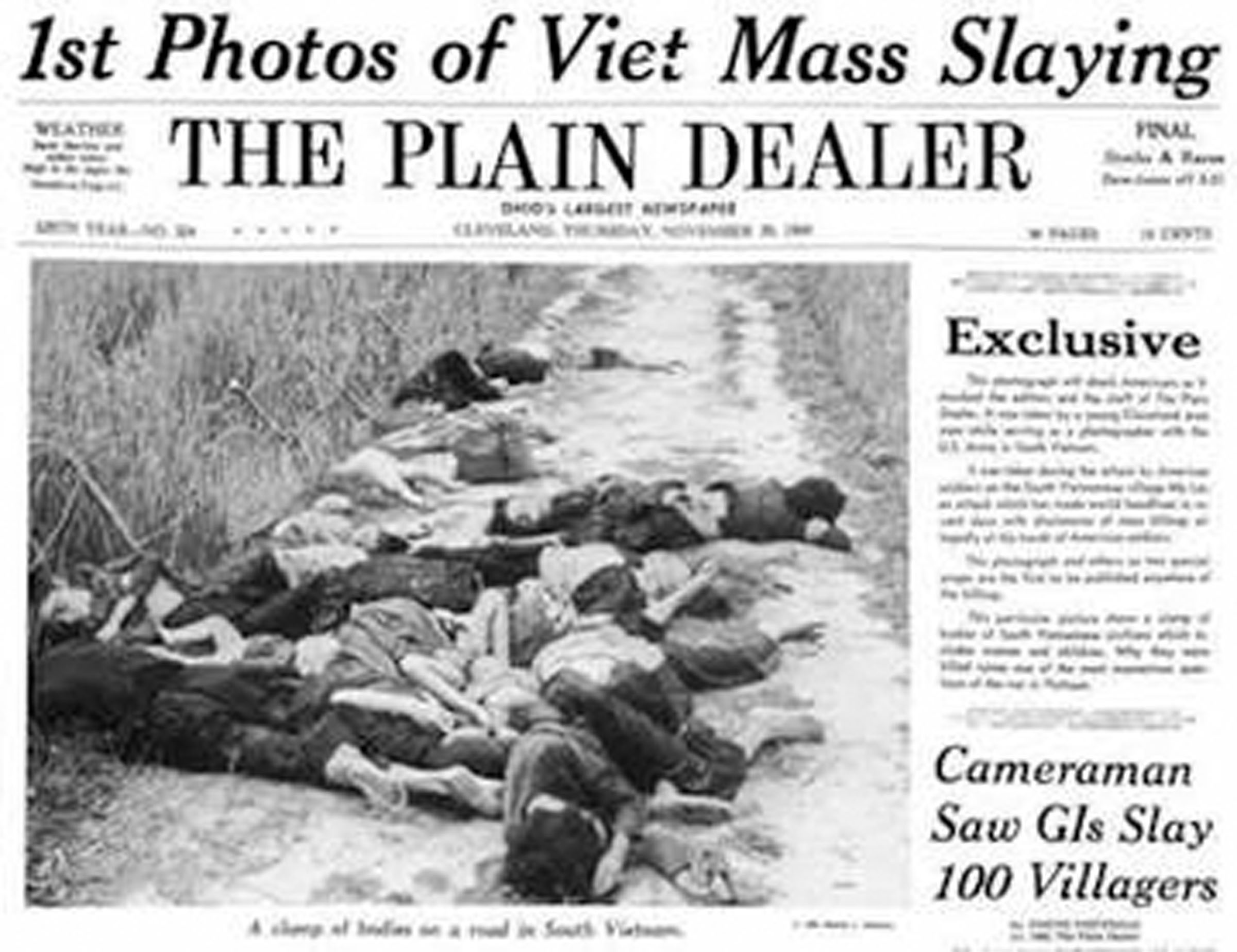
- Ronald L. Haeberle: Drafted US Army Sergeant 1966-1968, Army photographer in 1968, who went to My Lai to cover the army operation and found a slaughter of civilians. A year after he was discharged, he sent his photos of the My Lai massacre to the Cleveland Plain Dealer, indisputable evidence that prevented the U.S. government from covering up the atrocity.
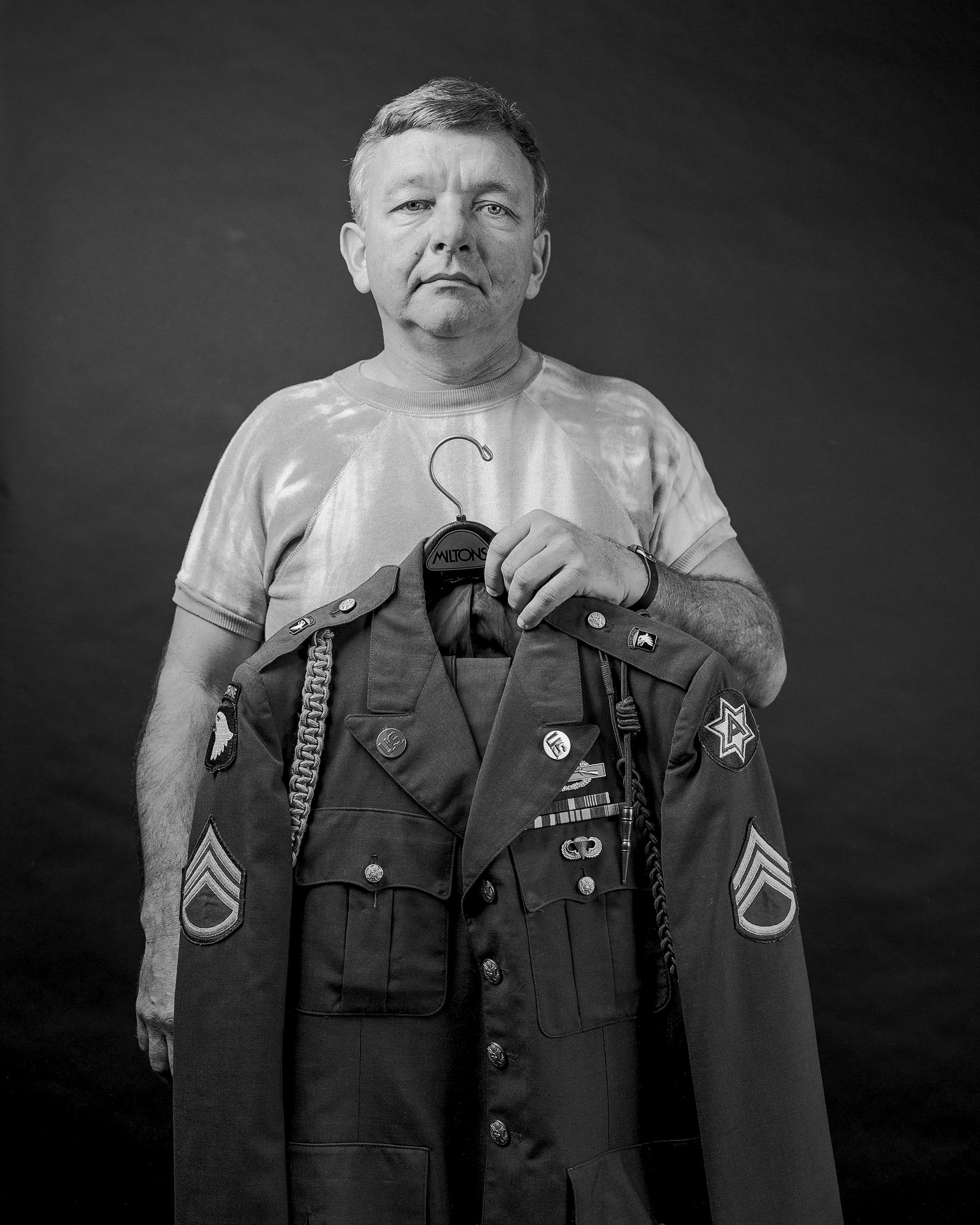
- Dennis Stout: Enlisted Army 1966-69. Served in VN with 101st Airborne. Recommended for two Bronze Stars, Silver Star, Distinguished Service Cross and Battlefield Commission to 2nd Lt. While in VN tried to report 14 war crimes. Immediately upon discharge went public.
Background and extra material:
- Average age of the soldiers in WWII was 26 and in Vietnam, about 21:
- Original Source was 1982 ABC News documentary about PTSD suffered by Vietnam War veterans: Vietnam Requiem – Wikipedia
- Watch it Online: Vietnam Requiem (1982) : Bill Couturié : Free Download, Borrow, and Streaming : Internet Archive
- Also referenced in the song “19” by Paul Hardcastle (1985)
- How to Tell a True War Story from the Things They Carried by Tim O’Brien
- Iron Triangle (Vietnam) – Wikipedia
- Pentagon Papers | Summary, Case, Vietnam War, & Facts | Britannica
- Operation Iron Mountain – Wikipedia
- Chieu Hoi – Wikipedia – Psychological Program by the US and South Vietnam to encourage defection by the People’s Army of Vietnam and Viet Cong.
- Mai Lai Massacre
- My Lai Massacre – Wikipedia
- March 16, 1968: Mỹ Lai Massacre and Hugh Thompson – Zinn Education Project
- Pulitzer Winning Article on My Lai
- Ron Ridenhour telling the story of becoming the whistleblower that revealed the My Lai Massacre: Ridenhour Prizes | History
- Information on the journalist who first broke the My Lai Massacre story
- “Another vet recalls Vietnam atrocities,” Toledo Blade story about Dennis Stout.
- International War Crimes
- International Law: Understanding justice in times of war – United Nations.
- Practice relating to Rule 113: Treatment of the Dead – International Committee of the Red Cross.
Songs:
- “I-Feel-Like-I’m-Fixin’-to-Die Rag” – Country Joe McDonald – 1967
- Additional music arrangement by Andrew Patinkin
- Other music arrangements are by Danny Seidenberg
- Solo Performance of the Six Verses of Vọng Cổ by Văn Vĩ
Listen to A Matter of Conscience:
Follow A Matter of Conscience:
Website: https://amatterofconscience.com/
Credits:
Producers and Hosts: Willa Seidenberg and Bill Short
Associate Producer: Polina Cherezova and Dylan Purvis Interns: Lizzy Liautaud and Dylan Ralls Sound Designer: Polina Cherezova
Music Arrangements: Andrew Patinkin, Danny Seidenberg Reading from How to Tell a True War Story, by Edward Lifson English translation of Vietnamese by Thi Khanh Linh Bui
Fiscal Sponsor: The International Documentary Association
Special thanks to the Kazan McCLain Partners Foundation. Thanks also to Denise Abrams, Bill Belmont, Le Cong Hau, Sam Short, and David Zeiger. And a big thank you to the veterans who shared their stories with us.


Episodie 13: War Is Hell
Willa Seidenberg 00:08
Hello, and welcome to A Matter of Conscience: GI Resistance During the Vietnam War.
Willa Seidenberg 00:20
I’m Willa Seidenberg.
Bill Short 00:36
And I’m Bill Short. This is the second part of our look at GI resistance in country, we warn you that this episode has vivid and disturbing descriptions of combat violence and sexual assault. You’ll also hear a lot of swearing.
Willa Seidenberg 00:54
When I was growing up in the late 1960s, my family watched the news on television every night.
Archival Sound-NBC News 01:01
American and South Vietnamese casualties rose last week. 166 Americans and 200 South Vietnamese were killed. Enemy dead were reported to be 14-hundred-31.
Willa Seidenberg 01:13
While the announcer gave the casualty numbers, viewers would see a full-screen graphic listing the grim statistics. I came from a family that was rather insulated from the consequences of the Vietnam War. That nightly report was a reminder to all Americans of the human cost of the war.
Willa Seidenberg 01:37
The average age of soldiers in World War II was 26. In Vietnam, it was about 21. Bill was exactly that age, 21, when he went to war. I didn’t know him when he went to Vietnam, but when I imagine our son facing the same circumstances at that age, my heart breaks a little, envisioning the life and death decisions these young warriors had to confront. Those young men are now old men with war stories. Vietnam veteran and novelist Tim O’Brien writes that a true war story is never moral. This is a passage from “How to Tell a True War Story” from his book, The Things They Carried.
Book Excerpt 02:26
In any war story, but especially a true one, it’s difficult to separate what happened from what seemed to happen. What seems to happen becomes its own happening and has to be told that way. The angles of vision are skewed. When a booby trap explodes, you close your eyes and duck and float outside yourself. When a guy dies, you look away and then look back for a moment and then look away again. The pictures get jumbled, you tend to miss a lot, and then afterward, when you go to tell about it, there’s always that surreal seemingness, which makes the story seem untrue, but which, in fact, represents the heart and exact truth as it seemed.
Bill Short 03:15
Army veteran Dave Cline was a soldier in Vietnam in 1967.
Dave Cline 03:20
Being over there, we didn’t do too much thinking or talking while we were there. You know, it’s like when you’re out in the field, go out there, you hump all day, you’re dirty and filthy and uncomfortable. I had a headache most of the time from the heat at night. You dig a hole, you eat your food, you take turns three in a hole, you guard duty one hour, sleeping two, you know. And then you’re up the next day doing it.
Bill Short 03:42
Dave wasn’t comfortable with the idea that he was there to kill commies,
Dave Cline 03:45
So, like I’d sort of latched on to that we’re going over there to help the people.
Bill Short 03:50
But it only took him one day in country to realize that he wasn’t there to help people either.
Dave Cline 03:55
Soon as you get there, the first thing they tell you is you can’t trust any of them. They’re gooks, they’re not human beings, you know, they’re all your enemy, don’t trust any of them.
Bill Short 04:03
Once Dave understood he wasn’t there to help anyone, the name of the game became survival. He was in an infantry unit operating about 25 miles north of Saigon. It’s an area known as the Iron Triangle.
Dave Cline 04:17
The first big firefight I was in, we got trapped in a horseshoe-shaped ambush, where they had concrete bunkers around us. I shot a lot of guys that day. I got hit in the back with a round, which caused my left lung to collapse. I was in the hospital for 45 days with that. Then I was sent back into the field.
Bill Short 04:36
Just 45 days in the hospital, then back to combat. Dave’s last battle was not long after that, in January of 1968.
Dave Cline 04:46
We were overrun by NVA, and this guy ran up to my hole and started shooting in, and I started shooting out, and he shot me through the knee, and I shot him through the chest and killed him. And they overran the whole base camp, and they had to pull me out of the hole and take me to another position and throw me in there with a bottle of Darvon.
Bill Short 05:04
The North Vietnamese soldiers took over their artillery positions and set them on fire. The whole base camp was in flames all night, so Americans couldn’t even fly in a chopper to medevac the wounded.
Dave Cline 05:17
So I laid in the hole all night. When the battle ended in the morning, they pulled me out of the hole, and they put me on a stretcher, and they carried me over to this guy I had shot. And he was sitting there dead, leaning up against his old tree stump, just sitting with his rifle across his lap, and a couple bullet holes through his chest, and the sergeant said, “Here’s this gook you shot, you did a good job, you know.
Bill Short 05:40
Dave said he didn’t feel any pride in having shot an enemy soldier who appeared to be about 20 years old, exactly Dave’s age. The army gave him a Bronze Star with a V for valor. The V is given for acts of heroism in direct combat against an enemy.
Dave Cline 05:56
They made up a story: my gun jammed, and we pulled back when I was shot. And in the story, they have me refusing medical attention, leading a counterattack, and driving the enemy into the jungle, bringing heroism and honor onto my unit. It’s all bullshit, you know. The person that actually went through my mind a lot was like, Why is he dead and I’m alive, you know? Because it was like it had nothing to do with being a better soldier, it was just whatever.
Willa Seidenberg 06:31
A 1967 Defense Department report confirmed that fabrications about the war were commonplace. It found that four presidential administrations had systematically lied to Congress and the American public about the scope of the war. That report became known as the Pentagon Papers. They were leaked to newspapers in 1971 by Daniel Ellsberg. He was an analyst for the Rand Corporation. Here’s Ellsberg speaking to a media mob when he turned himself in.
Archival Sound 07:07
I could no longer cooperate in concealing this information from the American public.
Willa Seidenberg 07:12
The Pentagon Papers questioned the accuracy of so-called body counts. The military used them to measure success in the war. You’ve heard several soldiers in this podcast talk about how body counts were inflated. These are the kinds of stories that got soldiers wondering why they were risking their lives in Vietnam. Marine veteran Steve Fournier was in Vietnam in 1967. He had believed in the Domino Theory. That was a term coined by President Dwight Eisenhower. He said that in order to protect democracy, the United States had to stop communism in Vietnam and elsewhere.
Archival Sound 07:55
You have a row of dominoes set up, then you knock over the first one, and what will happen to the last one is the certainly little go over very quickly.
Willa Seidenberg 08:06
Steve and his unit were stationed in Dong Ha, just about six miles south of the Demilitarized Zone between North and South Vietnam. They would carry out mine sweeps on the way to Con Tien, which was even closer to the DMZ.
Steve Fournier 08:22
Con Tien was a real living hell. I mean, there was nothing left up there. It had been defoliated, it had been napalmed, it had been burned. Constant incoming artillery from the other side of the Demilitarized Zone. It was a real hellhole, and the death and destruction were nothing like what I had imagined.
Willa Seidenberg 08:45
That was when Steve started considering the real consequences of the war. One night, his unit got into a firefight with the North Vietnamese Army unit. Steve heard someone moaning. When he crawled out to investigate the source of the moans, he found a dead NVA lieutenant.
Steve Fournier 09:04
I dragged the body back, had scapular metal around his neck, and he had a holy card pinned inside his front pocket, a holy card that looked very much like the holy cards that I had from Catholic school growing up, and a picture of himself and a young woman with a priest in front of a cathedral, evidently in Hanoi, where he was married. And he was obviously a Catholic, like myself. And I started to think, my God, are Catholics involved in this too? I just started to question, because of those kinds of things.
Bill Short 09:37
Most kids of World War II veterans will tell you their fathers didn’t talk much or at all about their wartime experience. Mine certainly didn’t. I understand why. It’s not comfortable to talk about what you did in combat with people who never experienced it. As Tim O’Brien writes, “if at the end of a war story you feel uplifted, then you’d be made a victim of a very old and terrible lie.” You may notice in some of our interviews that the veterans sound distant or nonchalant, or they may laugh at inappropriate times. Sometimes that’s the only way they can manage to tell their story without becoming a basket case. Ironically, the term “basket case” evolved from World War I. It was slang for quadruple amputees carried in baskets. Now we use it to refer to people who are emotional wrecks or feel hopeless.
John Tuma 10:38
I’m John Tuma. I was in the U.S. Army from July 1969 to January 1972 and was in the Republic of South Vietnam from February 1971 to November 1971.
Willa Seidenberg 10:55
By the time the army sent John Tuma to Vietnam, he was already against the war. He enlisted because he was about to be drafted. He was still in training in Washington, DC, during a big antiwar rally in May of 1970. The army had given soldiers strict orders not to take part in the protest.
John Tuma 11:20
I ended up working in an aid station over in Georgetown in DC. I probably should have marched and made a bigger statement, but I ended up taking, I guess, a way out. I guess I was able to still support what was happening and things, but at the same time, was not actually disobeying the direct orders to not march.
Willa Seidenberg 11:45
The army court-martialed him anyway. John had signed up for language school because it required extra training. He thought maybe the war would be over by the time he finished. No such luck. The war was still in full swing when he finished language school, so he signed up for six weeks of interrogation training.
John Tuma 12:06
In February, and ‘71 ended up in Vietnam.
Willa Seidenberg 12:10
John’s first duty station was in a Military Intelligence Detachment. He worked with interpreters from the Army of the Republic of Vietnam, referred to as ARVNs. They were allied with the United States.
John Tuma 12:24
It was a standard operational procedure that we have a Vietnamese interpreter with us in order to make sure that any nuances of the language didn’t escape us, and to, I guess, also check up on us. The first person I went with was to interrogate an NVA soldier who had been brought in during Operation Iron Mountain.
Willa Seidenberg 12:50
Operation Iron Mountain was a two-year campaign in a province called Quang Ngai. That’s the same area where Dave Cline’s unit was patrolling. During the interrogation, John realized that the Vietnamese interpreter was yanking the prisoner’s earlobe down below his chin line.
John Tuma 13:10
And I told him to stop, and he stopped for a second, and then started doing it again, and I said, “No, you can’t do that.” Finally, I just called off the debriefing and said I can’t work with this, and went back and requested another Vietnamese interpreter to come with me. And the same thing happened again.
Willa Seidenberg 13:32
The next debriefing was of a suspected Viet Cong soldier who’d been shot and brought to a hospital. The prisoner originally told the soldiers he wanted to be a Chieu Hoi. That was the name U.S. and ARVN forces gave to a program aimed at getting communist soldiers to defect.
Archival Sound: U.S. Marine Corps Film 13:32
The Chieu Hoi program, the open arms answer to the war in Vietnam, has paid off. A North Vietnamese Army captain has come over to our side, bringing with him not only arms and ammunition, but hope for the people of South Vietnam.
John Tuma 13:54
Once he goes to the hospital, he decided he didn’t want to be a Chieu Hoi. He said no, he’d never been in Viet Cong, and he was in a village defense group, but they were just defending their village from anybody who happened to come through.
John Tuma 14:23
We had nothing that showed that he had ever been Viet Cong, and I classified him as being a civilian, possibly civilian defendant. The South Vietnamese I was working with kept pinching off his IV tubes while we’re talking, and I kept saying, “Don’t do that.”
Archival Sound 14:48
After an enemy surrenders, he or she is taken to an interrogation center. There, he is asked to voluntarily furnish information about the enemy’s immediate tactical situation.
John Tuma 15:00
And I refused to work with them and refused to reclassify the individual as a prisoner of war rather than as a civilian, without direct written orders. And as a result, I was transferred out of the MI detachment.
Bill Short 15:19
John was out of the Military Intelligence unit and the army assigned him to a civilian affairs liaison team.
John Tuma 15:26
When I was first there, I visited one Vietnamese compound and saw what I recognized as a quote unquote, bird cage, which is a strand of barbed wire hung from a tree, wrapped around an individual, left to swing, wrapped up in barbed wire until he decides to come up with whatever information his captors believe he has. I made a report on this, and it was eventually taken down.
Bill Short 16:03
John got the bird cage taken down, but he paid a price for it.
John Tuma 16:07
I ended up having a percussion grenade tossed at my hooch in the middle of the night.
Bill Short 16:14
The grenade in his hooch wasn’t the only threat he received. Another incident happened when he was sent to evacuate a refugee camp, along with some South Vietnamese soldiers.
John Tuma 16:24
Got to the edge of the village, and I said, it’s just a little farther. And we went through the tree line, and still a little farther. And I realized that they were acting very nervous and very suspicious, and they started running forward when we got to like a small ravine. And I started running back to where the rest of the Americans were, and keeping to the trees, and then when I got to the edge of the village, the hooches behind me, and there was firing from behind me at that point. I assumed that they were not supposed to bring me back.
Bill Short 17:00
In the nine months John was in Vietnam, he was constantly confronted with disturbing episodes. He used to hear screams coming from one of the ARVN intelligence units when they were interrogating prisoners. One time, he was brought in to talk to a prisoner who appeared to be a Montagnard, that’s the name for an indigenous minority tribe who live in the Central Highlands of Vietnam.
John Tuma 17:22
In order to try to make him speak Vietnamese or English or French, the South Vietnamese sergeant in charge would take a piece of electric wire and start beating him around the head and shoulders with this, like a cat nine tail he made out of electric wire. And I did step in between him and told him not to do it, and was dragged out physically by another American for interfering with the Vietnamese methodologies.
Bill Short 17:52
Another time, a sergeant ordered him to call in an artillery strike on a town that John was convinced was a civilian village.
John Tuma 18:00
I refused. He threatened to have me court-martialed. I just walked away, and he called it in himself, and ended up later on being court-martialed, because it turned out that there were Vietnamese civilians and families of South Vietnamese rangers living in the ville.
Bill Short 18:17
John got many threats of court-martial for his refusal to take part in torture in Vietnam, but he was never tried.
John Tuma 18:24
I said that was perfectly willing if they would put the orders in writing for me to do specifically what they wanted me to do, either work with South Vietnamese interpreter who was going to coerce confessions out of people, or if they wanted to put in writing that they wanted me to illegally change classifications of prisoners, if they wanted to put those orders in writing and let me have a copy, I’d be more than willing to do it if they wanted to take that type of responsibility. And they shut up very, very quickly about ordering me to do it, or court-martialing me.
Bill Short 19:02
It’s astonishing that a young 21-year-old would have the moral courage to put himself at such risk in a war zone, but in these moments, John got the strength by thinking about his family.
John Tuma 19:12
I remember I used to think, what would my parents have done? The way I was brought up, what would be the right thing to do, not the right thing to do from an army point of view, but what’s the right thing to do with my own family, my own community’s morality, and things like that. I had consciously thought about that and came to the conclusion that were things that I had been raised not to do, and I wouldn’t want to do.
Archival Sound: CBS News 19:43
Is there a rebellion today? You might call it that. Back in the world, they call it rebellion. Here it’s just downright refusal.
Willa Seidenberg 19:51
These war stories give true meaning to the old saying, “war is hell.” But in Vietnam, what many soldiers didn’t anticipate were incidents that went beyond acceptable warfare tactics. The most famous war crime during Vietnam was the My Lai Massacre. It took place in a few hamlets in March of 1968. U.S. Army soldiers murdered up to 500 unarmed civilians — women, children, and old people. Some of the women and children were raped.
Ha Thi Qui 20:33
I’m one of the survivors of the massacre. My name is Ha Thi Qui. I’m 69 years old.
Willa Seidenberg 20:43
Qui is one of two survivors of the My Lai Massacre that we interviewed in 1994 on one of our trips to Vietnam. Before the interviews, we toured a small museum and the site of the massacre, which is now a memorial. We were already weighed down with a sense of profound sorrow when we sat down to talk to the survivors. Ha Thi Qui told us that American soldiers had come to their village twice before, but the third time was different.
Ha Thi Qui 21:21
I thought to myself, Americans have been coming all the time, so why is there strange aircraft coming today?
Willa Seidenberg 21:28
Rockets from helicopter gunships started raining down on the village, and then the soldiers herded everyone into a ditch. Ha’s daughter was crying.
Ha Thi Qui 21:42
She was 18 years old, but she had a kid already. My daughter kept asking to be let go, but the soldiers pushed her with their rifles. Then they started shooting everyone. Some people were shot in their heads, their ears, and their eyes. When the bullet first hit me, my body heated up. It feels so hot, it makes me go crazy. But then I felt the shivering cold. My daughter and her child, my two grandchildren, and my mom were killed.
Willa Seidenberg 22:51
We also spoke with Truong Thi Le, who was from a different hamlet. She said the soldiers used their rifles to violently push the villagers to the main road.
Truong Thi Le 23:05
The soldiers told us to sit down in two lines on the main road next to the rice paddy. Then they started to grab each of us. I had a 17-year-old daughter, and I was scared that she got raped, so I told her to go sit next to her grandma. I was holding my six-year-old son.
Willa Seidenberg 23:31
Truong, and her young son were lying next to the rice paddy. She tried to play dead and hide her son under her body. All this time, the soldiers were shooting at the villagers.
Truong Thi Le 23:46
Three bodies fell on me. My son was suffocating, so I nudged him aside. I saw the soldiers coming, and I closed my eyes to look dead, but my son didn’t see them, and he moved. The soldier saw that and shot him.
Willa Seidenberg 24:02
Truong was horrified and terrified, but she still had to pretend to be dead. She cracked her eyes open and saw that the soldiers had passed by her, so she got up to find her daughter. But she had to walk gingerly to avoid stepping on bodies.
Truong Thi Le 24:27
I slowly walked to my daughter, who was severely wounded. I asked her, “What should I do? Everyone has died. I am the sole survivor.” I asked if she could walk with me, she responded, “No, Mom, I can’t live anymore. I am wounded really bad.” I came closer and saw her intestine exposed. My daughter urged me to go. She said, “You have to run away. If you stay here, it might come back and kill you, too.” I walked away, but it was heart-wrenching. I walked slowly through the lines of bodies. I said, if anyone is still alive, please get up and go with me. No one responded.
Ronald Haeberle 25:23
There’s just complete carnage going on there.
Bill Short 25:34
This is Ron Haeberle. He was an army photographer in 1968. He and a military writer went to My Lai to cover the army operation. They thought it was going to be a big battle between American and Viet Cong forces. Instead, they found a slaughter of civilians.
Ronald Haeberle 25:51
Everything was being wiped out: old men, women, children, babies, pregnant women. It’s just amazing what happened there. Every place we go through the village, all we’re doing is finding bodies all over the place.
Bill Short 26:05
There was nothing Ron or others could do to stop the killing without putting themselves at risk. So, he did the only thing he could think of. He documented the carnage using his personal camera, not the one issued by the military.
Ronald Haeberle 26:18
One thing I’ll never forget, I took a photograph of the bodies there. I was getting ready to take another photograph of the bodies, but I saw a small child walking toward the group of bodies, like he’s trying to find his mother. He was already wounded, shot in the arm. Just before I was getting ready to take my photograph, I didn’t know at the time, but a GI stood right beside me. I was in a crouch position, and he shot the kid. Through my viewpoint, I can see this kid being shot up in the air, flipped over, and it came down on the pile of bodies.
Bill Short 26:49
News of the massacre came out more than a year later through the efforts of veteran Ron Ridenhour and journalist Seymour Hersh. After Ron Haeberle was discharged from the army, he sent the photos he took with his personal camera to the Cleveland Plain Dealer. Only one soldier was ever convicted of crimes associated with the massacre.
Archival Sound: AP News 27:12
Lieutenant William Calley was found guilty of premeditated murder in the slaying of 22 South Vietnamese civilians at My Lai.
Bill Short 27:19
Lieutenant William Calley was originally given a life sentence, but three days after his conviction, President Richard Nixon ordered him to be released and put under house arrest.
Willa Seidenberg 27:44
The world was shocked when revelations of the My Lai Massacre made headlines more than a year later. But soldiers in the field were seeing atrocities almost daily. A war crime is a serious violation of international humanitarian law, as defined by international treaties — things like using torture or intentionally attacking civilians.
Bill Short 28:11
When I was in Vietnam, I witnessed something that was so utterly horrific that it really shocked me to the core. But at the time, even though it was shocking, I didn’t understand it as a war crime, but today I truly believe it was. We came back from an operation, I think it was a three- or four-day patrol of the jungle. And when we got back and started breaking down our equipment, one of the guys in my platoon came over and said, “Hey, Sarge, you know, so and so has a head.” I said, ‘Where’d he get it?” He said, ‘He cut it off a body when we’re on the last operation.” I said, ‘You’re kidding me.” He said, ‘No, he’s over there cleaning it and stripping the skin off of it.” I said, ‘Really?”
Bill Short 28:55
So, I went over to check it out, and I saw him with his steel pot. The steel pot is the metal cover over the fiberglass helmet that you wear in combat. In the field, we would take the steel pot off and mix it with Kool-Aid and water to make Kool-Aid in the field. So, here this guy had this head in the steel pot with diesel fuel and a toothbrush, and he was scrubbing the skin off of the skull. I was just flabbergasted, and so I went to the company commander, and I thought the company commander was going to go over and reprimand him. But what I discovered later was that the company commander actually went over and took the head from the guy after he cleaned it, sent it back to our big base camp to our main rear area at the company office at the end of our company street. He put it on a stake out in front of the company office. So, we had this Viet Cong skull on this post outside the office, and it was there for a while.
Bill Short 29:59
Then he was forced to take it down, not because he realized it was wrong, or because a bunch of GIs told him that it was disgusting. It’s because the Vietnamese, the young women who cleaned our hooches and cleaned the office, refused to go inside. They refused to go past this head to get inside the hooch, so they couldn’t get anybody to clean. So, finally, he relented and took it down. You hear about guys cutting off ears and fingers, and you know, occasionally guys would go up, and if there was a body, they’d even – the body was dead – they’d empty their full magazine in it out of anger. And you know what, I’ve come to realize now that desecrating a body is actually internationally considered a war crime that there’s supposed to be respect for that dead person that died, and we certainly didn’t exercise that.
Archival Sound: CBS News 31:03
This is what the war in Vietnam is all about, the old and the very young. The Marines have burned this old couple’s cottage because fire was coming from here.
Willa Seidenberg 31:19
Army veteran Dennis Stout tried to become a whistleblower when he witnessed war crimes. Just like John Tuma, Dennis always kept family and church values in mind when he was a soldier.
Dennis Stout 31:34
In church, they’d always taught me that if you see something that’s wrong, you have to do whatever it takes to correct it, even at the cost of your own life. I don’t think they intended me to apply it, how I later did, but that’s the lesson that really came through to me.
Willa Seidenberg 31:50
Dennis went to Vietnam in 1966. He got a big shock on his very first patrol in Vietnam about two weeks after he arrived in country. It was on a training patrol. Some old timers were walking the newbies on the edge of a rice paddy. A farmer was plowing his field with his water buffalo.
Dennis Stout 32:12
And he saw us walking through the edge of the woods, and he just went, “Hey, GIs” and waved. And the guy that was leading us pulled up and shot him off that, just shot him for no reason. And it was just shocking to me. And they just made a, you know, they thought that was the funniest thing, you know. They shot him while he was waving.
Willa Seidenberg 32:28
Dennis was with the 101st Airborne, a highly decorated division of the army. In his first real operation, his unit took a village with no resistance to speak of. They were ordered to search bunkers in the village. Dennis was paired with a more experienced soldier and told to do exactly what the other soldier did.
Dennis Stout 32:51
He held up a grenade, and he pulled the pin out, so I pulled the pin out of mine, and he flipped the handle, so I flipped the handle of mine. And then he yelled in English, “Get out of there, you dirty gooks” because we had heard noises down inside there. And then he threw his grenade in, and I threw mine in. And when they exploded, we heard these kids start screaming. So, he pulled another grenade and threw it down, and I threw another one down, and they went off. And then I think he threw another one in until all the noise stopped inside. And then we took, like, a lunch break.
Willa Seidenberg 33:18
After the smoke cleared, they went to count the bodies.
Dennis Stout 33:23
There was nobody between the ages of 15 and 50, except mothers with children. Maybe some of the old people were 40. I mean, they looked 50 or 60, but they were just people hiding in this bunker.
Willa Seidenberg 33:35
Dennis decided then that he was going to learn enough Vietnamese so he could talk people into surrendering.
Dennis Stout 33:42
I could finally do it with a Vietnamese accent, enough, you know, that I got a few, got people to surrender and come up, but then they’d be tortured and raped and shot, and I didn’t know what was right.
Bill Short 33:56
Other incidents happened that had Dennis morally confused. In one village, all the residents had vanished. The soldiers were ordered to destroy the garden. When they took a break, they noticed an old woman in the garden.
Dennis Stout 34:08
And she had been stacking up pieces of squash and melon back together, you know, finding the ones we’d hacked up and like stacking them back together again. And so, I had to walk really slowly with her, but walk her back over to where we were.
Bill Short 34:21
They weren’t sure what to do with her, but an intelligence staff sergeant came along. He told them not to worry, that he’d take care of her.
Dennis Stout 34:28
We moved just a little way when he heard this gunshot. He shot her and reported her as a VC killed.
Bill Short 34:34
Months of combat dragged on for Dennis, with more upsetting acts against the Vietnamese. Wounded soldiers and civilians would sometimes ask Dennis to shoot them just to put them out of their misery.
Willa Seidenberg 34:47
One time, he was guarding a young Vietnamese woman, and he let her escape. But another time, he wasn’t able to save anyone. And this was an incident that haunted him. The soldiers had set up a barrier on the road and were robbing civilians as they passed through. That was bad enough, but then they grabbed a young woman and imprisoned her.
Dennis Stout 35:09
At night, they got her out and started raping her on the other side of the perimeter and then carrying her from position to position. I could hear them slapping her, and all this stuff. I didn’t know what I was going to do when they came to my position. I mean, these guys I really cared about. I was really close to them, closer than brothers, closer than family, and I just didn’t know what to do.
Willa Seidenberg 35:29
Just before they came to Dennis, the GIs stopped at another soldier’s position. It was a medic who had recently arrived in the unit.
Dennis Stout 35:38
And he said, “No, this is wrong, and it’s not moral.” And they beat him and broke two of his ribs and put a pistol against his head and told him they would shoot him if he ever said another word about anything like that.
Willa Seidenberg 35:49
Dennis was anxiously trying to figure out what to do when it was his turn. He told them he was going back to the world soon and didn’t want to bring any diseases home to his wife. His fellow soldiers seemed to accept that explanation and moved on. The next morning, the soldiers tried to get the woman to run so they could shoot her.
Dennis Stout 36:10
She wouldn’t, so they threw a grenade at her feet, and she covered up her face with her hand, and the grenade blew one leg almost completely off and the other partially. And then one of the guys walked over and shot her in the head a couple times, and I just decided I couldn’t take it anymore. It was just the end of a string of things.
Bill Short 36:29
The next day, his unit was in a firefight that got them recommended for medals.
Dennis Stout 36:33
I was walking back toward the highway, and instead of going back to the unit, I just made a left turn and walked down the highway to our firebase and went to the sergeant major, who was my direct superior, to report the crime.
Bill Short 36:46
The main crime he wanted to report to his commanding officer was the rape and murder of that young Vietnamese woman.
Dennis Stout 36:52
He turned it down and told me to keep quiet. He just said, “Keep quiet, or you’ll get a lot of good people in trouble.”
Bill Short 36:58
Dennis went to his captain, who told him the same thing, and then he paid a visit to the chaplain.
Dennis Stout 37:04
Oh, within half an hour, someone came and found me and told me to report to the sergeant major, and he said, “The chaplain tells me you’re being a troublemaker.” He said, “If I hear another word about this, you’re going to go out on the next operation, you’re not going to come back alive.”
Bill Short 37:16
Dennis realized that the only way he could make it home alive was to put his head down and keep his mouth shut for the rest of his time in Vietnam. He stayed as far away as he could from the other guys in his unit.
Dennis Stout 37:28
It just was such a conflict inside of me that these guys could do that kind of thing. So you know, I don’t trust very many guys. It’s like there’s this violent side that I feel, and those guys came out, and they could do this kind of stuff, and it’s been very hard for me to make male friends. I do make some, but I don’t hang out with guys. I just, anything that begins to get toward that attitude, you know, anytime racist or sexist stuff comes up, I get really turned off to being with guys.
Bill Short 37:57
Just before he left Vietnam, Dennis was wounded.
Dennis Stout 38:01
Two guys in front of me stepped on a land mine, and it killed a guy in front of me, tore part of his head off and one arm, and I got a few pieces that went through him. I got hit in the hand and the knee and the foot. One piece went through my foot, and the one that hit me in the knee chipped some bone chips loose.
Willa Seidenberg 38:16
Dennis still had a year and a half left in his commitment to the army. He was sent back to the States and was supposed to redeploy to Vietnam six months later. He put in for duty at Fort Huachuca in Arizona to work at a Vietnam training group, and he had surgery on his knee to clean up those bone chips. Dennis thought the military was capable of anything, so he kept his mouth shut. He had a wife, a daughter, and another one on the way. A lot of reasons to make it out of the military alive. He was never sent back to Vietnam and was released from military duty in February of 1969.
Dennis Stout 38:58
Six days later, I officially reported eight war crimes that I could more closely document. I had 14 that I felt were like major violations, although I’m not sure now whether what’s a major and what’s a minor.
Willa Seidenberg 39:11
Dennis was immediately visited by CID, the Army’s Criminal Investigation Division. He gave them documents to prove his allegations. The CID officers took the documents, but Dennis never saw them again.
Dennis Stout 39:28
The government asked my neighbors to spy on me, because my neighbors came over and said, “God, the government came and told us to watch you and tell them if anything happens. And I came under harassment, them going to my, you know, people I had jobs with, and telling them I was an agent of foreign power, and that, you know, I was a communist, and stuff like that.
Bill Short 39:47
His GI benefits were withheld, and he got calls threatening his kids, or sometimes saying his wife was having an affair. Nevertheless, Dennis continued to speak out against the war. The night before, he was scheduled to make a speech at the Federal Building in Phoenix, two CID agents came to his home.
Dennis Stout 40:08
With my wife standing in the living room. They said, “We hear you’re going to make a speech tomorrow at the Federal Building,” and I said, “Yes.” And the agent said, “If you make that speech, you know that you could go to work some morning and disappear, and no one would ever know what happened to you,” and then he took his finger and poked me really hard in the chest, and said, “And you know we can do it too, don’t you?” And you know, I figured he really could.
Bill Short 40:28
Dennis bravely carried through with that speech, then went to Hawaii to hide out. His accusations were later confirmed by a Toledo Blade investigation. The newspaper found that in the early 1970s, the Army Criminal Investigation Division investigated his unit for alleged war crimes. They used sworn testimony from a number of veterans in the unit. During his time in country, Dennis was recommended for two Bronze Stars with a V, the Silver Star, a Distinguished Service Cross, and a battlefield commission to second lieutenant. You can see my photo of him holding his uniform and medals on our website, amatterofconscience.com. And by the way, that’s a lot of medals for any one GI to get.
Willa Seidenberg 41:14
Throughout this podcast series, you’ve been hearing parts of Bill’s story. He was a squad leader and then a platoon sergeant in an Army infantry company. After four months in combat, he and two others in his platoon refused to keep fighting. We’d like for you to hear more details of his story, because they’re representative of many soldiers who served in country and turned against the war. We’ll bring you more of Bill’s first-person experiences in upcoming bonus episodes.
Bill Short 41:50
This podcast was independently produced with crowdsourced funds. We thank the dozens of people who donated, and you can join them by going to our website, amatterofconscience.com. You can see a glossary of terms and show notes for this episode. If you like what you heard in this episode, please give us a review and tell others about it.
Willa Seidenberg 42:16
This episode was written, edited, and produced by Willa Seidenberg, with help from Bill Short. Polina Cherezova is the sound designer, and Dylan Purvis is the associate producer. Our USC interns are Lizzy Liautaud and Dylan Rawls. Many thanks to Country Joe McDonald, who, before he died, gave us permission to use his song as our theme music. Additional music arrangements in this episode are by Andrew Patinkin. Other music arrangements are by Danny Seidenberg. The Vietnamese music is by Văn Vĩ. The passage from “How to Tell a True War Story” was read by Edward Lifson. English translation of the My Lai survivors is by Thi Khanh Linh Bui. We thank the Kazan McClain Partners Foundation for their generous support. Our fiscal sponsor is the International Documentary Association. Thanks also to Denise Abrams, Bill Belmont, Le Cong Hau, Sam Short, and David Zeiger. And finally, a big, big thank you to all the veterans who shared their stories with us.